What NAICS code do I actually need?
Published
Start with the work customers pay you to do.
"We clean office buildings" is a useful starting sentence. "We provide complete business solutions" gives you very little help choosing a code.
NAICS, the North American Industry Classification System, sorts businesses into industries. Federal buyers use those codes to classify purchases. The code also connects a purchase to the size limit a small business must meet.
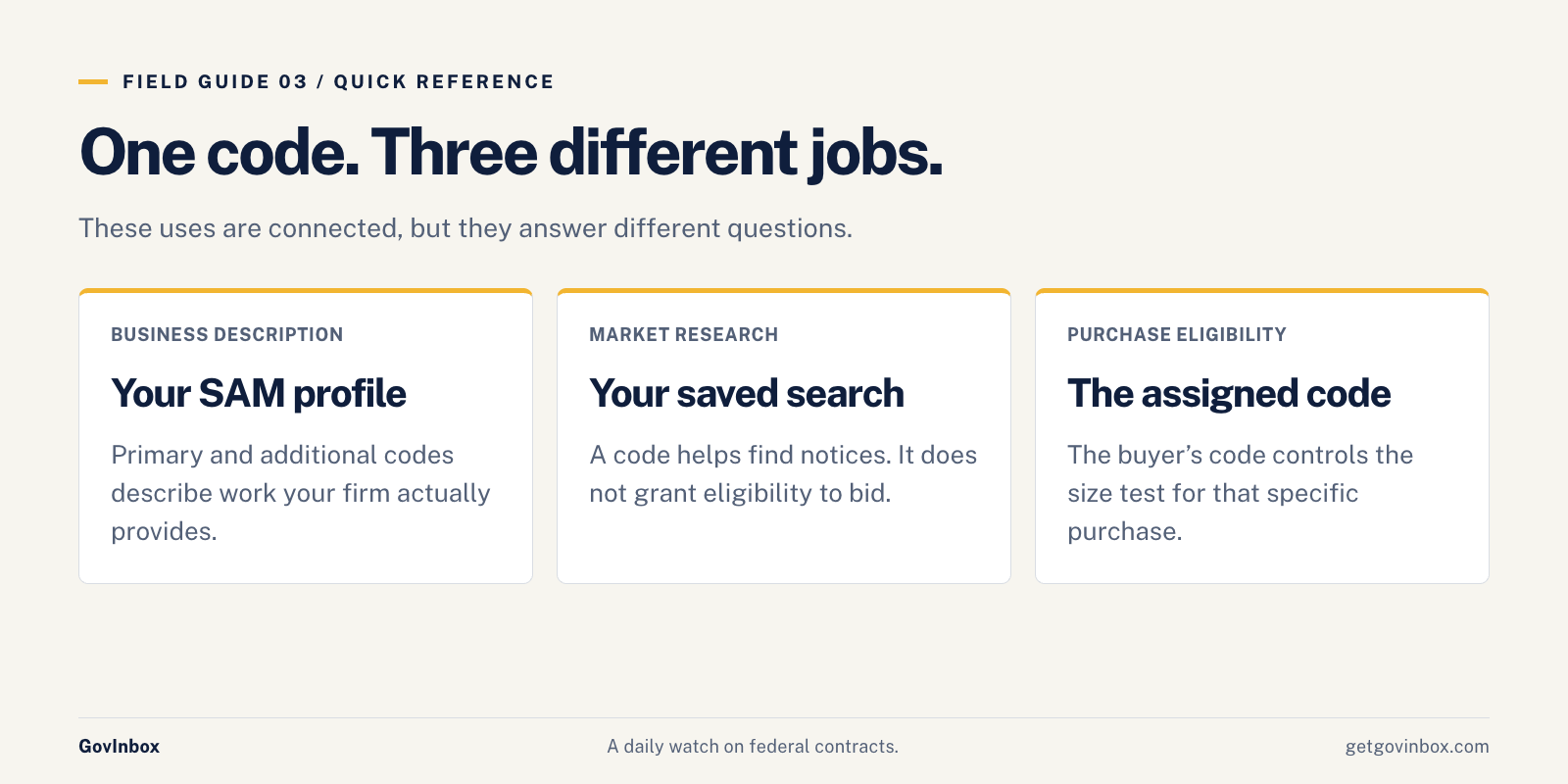
You will use NAICS in several places, but each use answers a different question.
The codes on your SAM registration
Your SAM profile describes what your business does. It can include a primary NAICS code and other codes for work you actually provide. See SBA's registration guidance.
Choose the primary code that best reflects your main business activity. For an established firm, look at where most of your revenue comes from. For a new firm, use the activity the business is actually set up to perform.
Do not pick a primary code because it appears on an attractive contract. A janitorial company does not become a construction business by adding a construction code.
Additional codes can make sense when you provide different services. Be ready to explain what you do under each one.
The codes in your searches
Search codes help you find notices. You can search a code while studying a market, even if it is not your primary code.
Begin with your primary code. Read enough matching notices to learn whether buyers use it for the kind of work you want.
Then test related codes separately. If you combine everything at once, you will have trouble seeing which filter produced useful results.
A search filter is a way to find work. It does not grant permission to bid.
The code assigned to a purchase
The contracting officer, the agency official responsible for the purchase, assigns the code that fits the work. That code has a size standard, a maximum revenue or employee count for a business to count as small.
The assigned code controls the size test for that purchase. Your preferred code does not replace it. SBA explains procurement codes and size standards here.
You may be small under one industry's limit and too large under another. Related businesses may also count toward your size. Certification under a special program does not remove that test.
If the assigned code seems wrong, ask for guidance promptly. There is a formal appeal process with a short deadline. Changing your SAM profile will not change the solicitation, the buyer's request for offers.
Choose a primary code by working backward
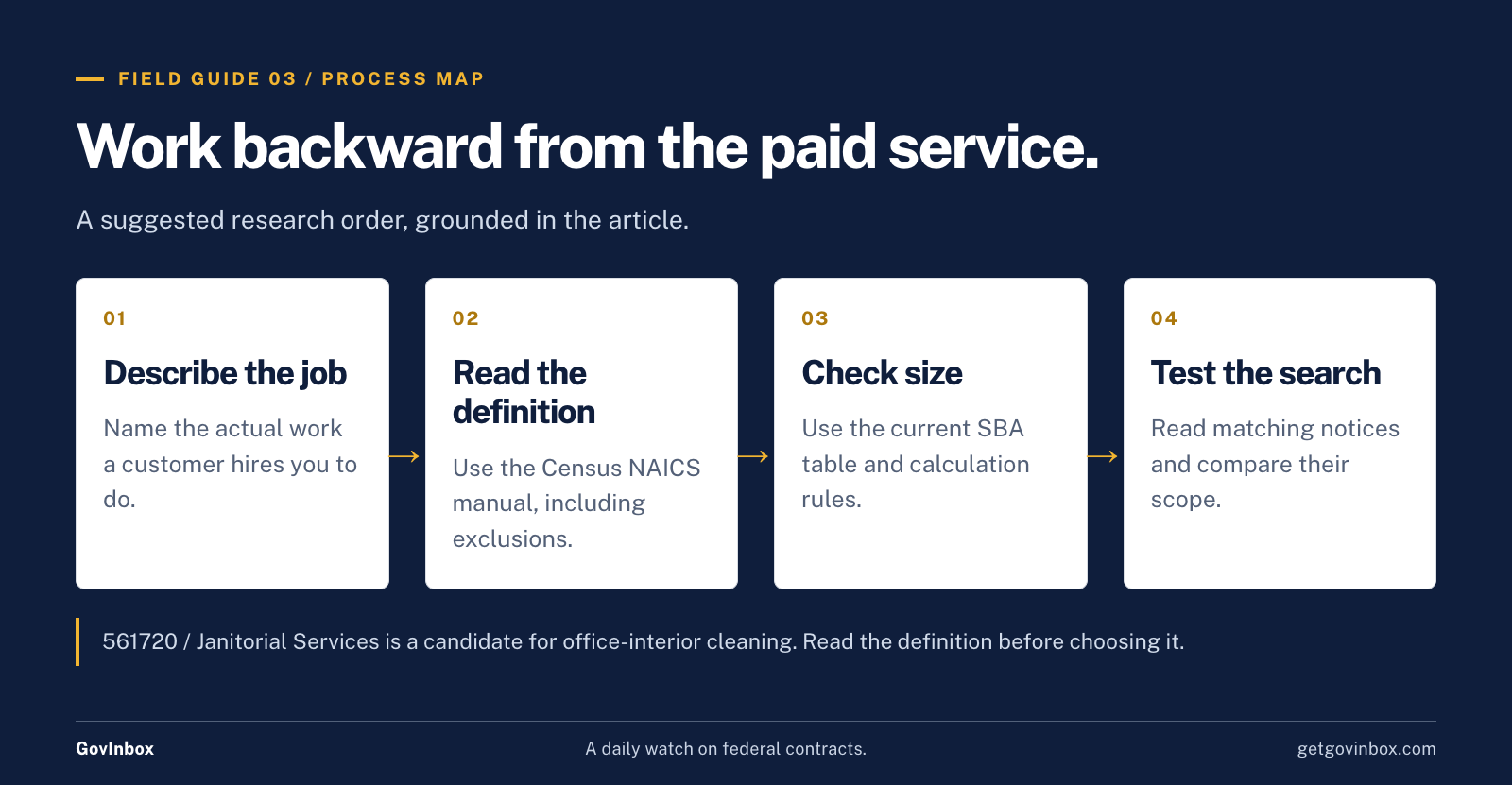
Write down your main paid service in one sentence. Name the actual job a customer hires you to perform.
Next, look it up in the Census Bureau's NAICS search and manual. Read the full definition and exclusions, which tell you where similar work belongs.
Suppose you clean office interiors. NAICS 561720, Janitorial Services, is a candidate. Read its definition before choosing it. If your main work is a specialized trade, a cleaning-related word in the title may point you toward the wrong industry.
Check the current SBA size table for your candidate code. Use the calculation rules for the listed measure, rather than comparing the limit only with last year's sales.
Now search that code on SAM.gov and read the work descriptions. Keep examples that match what you do. If most results cover a different service, return to the definitions.
Use watch data to test the search
The busiest codes tell you where notices are being posted. They can help you choose what to investigate.
They should not choose your business description for you. A busy code is useful only when its work fits your firm.
Look at relevant notices under your candidate code. Which buying offices use it? Does the attached work description match your service? Make notes about related codes that show up in work you could also perform.
Leave with a code and a search
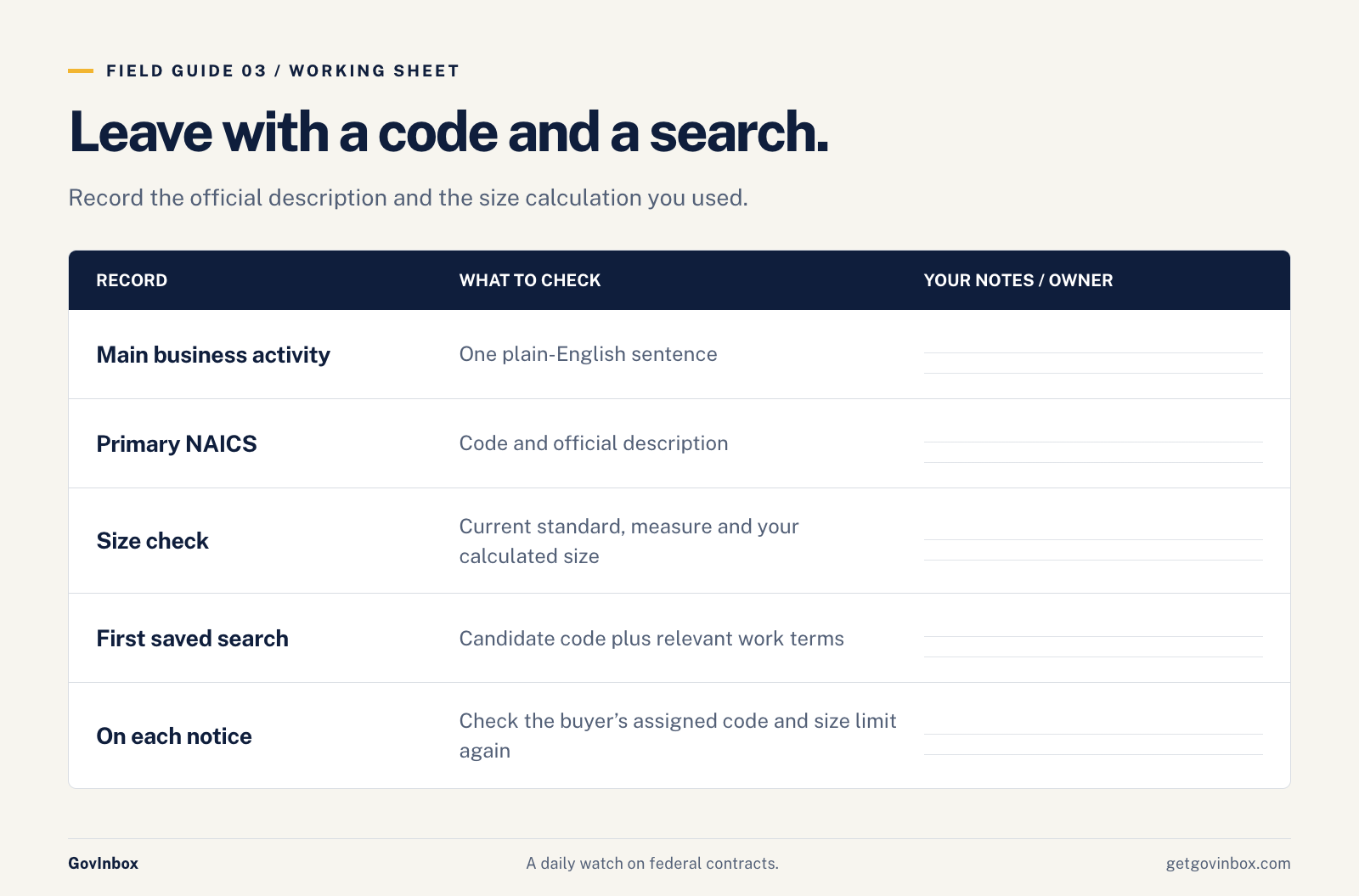
Fill in these lines:
- Our main business activity is: ______.
- Our primary NAICS code and official description are: ______.
- The current size standard and our calculated size are: ______.
- Our first search will use that code with these work terms: ______.
Choose your primary code from the work you actually do. Keep your SAM profile accurate, then save a search using that code. On every promising notice, check the buyer's assigned code and size limit again.