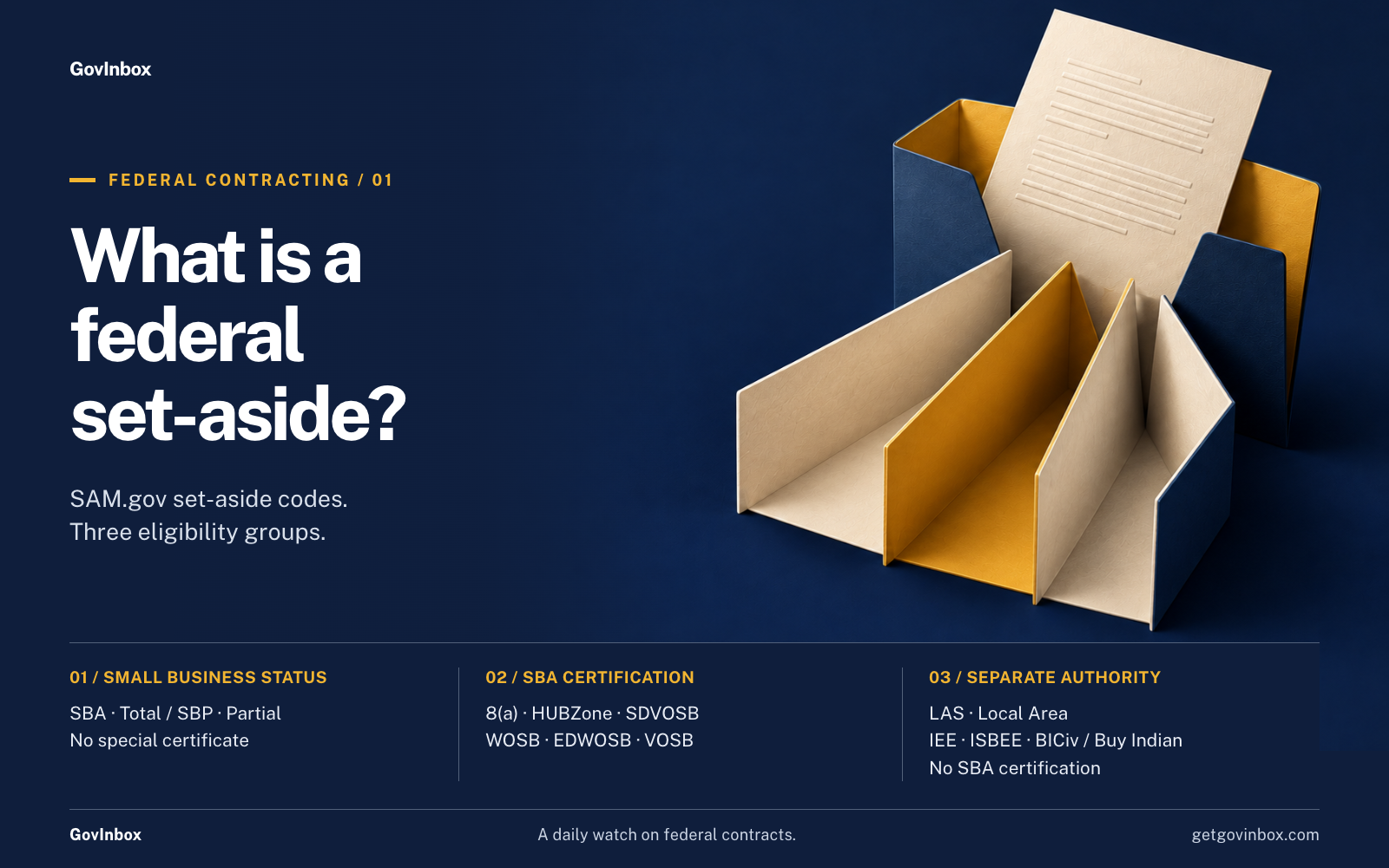
What is a federal set-aside?
Published
Yes, there are federal contracts reserved for small businesses. The notice will tell you which businesses can compete.
That limit is called a set-aside. It can cover small businesses generally or a narrower group, such as certified women-owned firms. It can cover the whole purchase or only part of it. You still have to meet the contract's requirements and submit an offer the agency can accept.
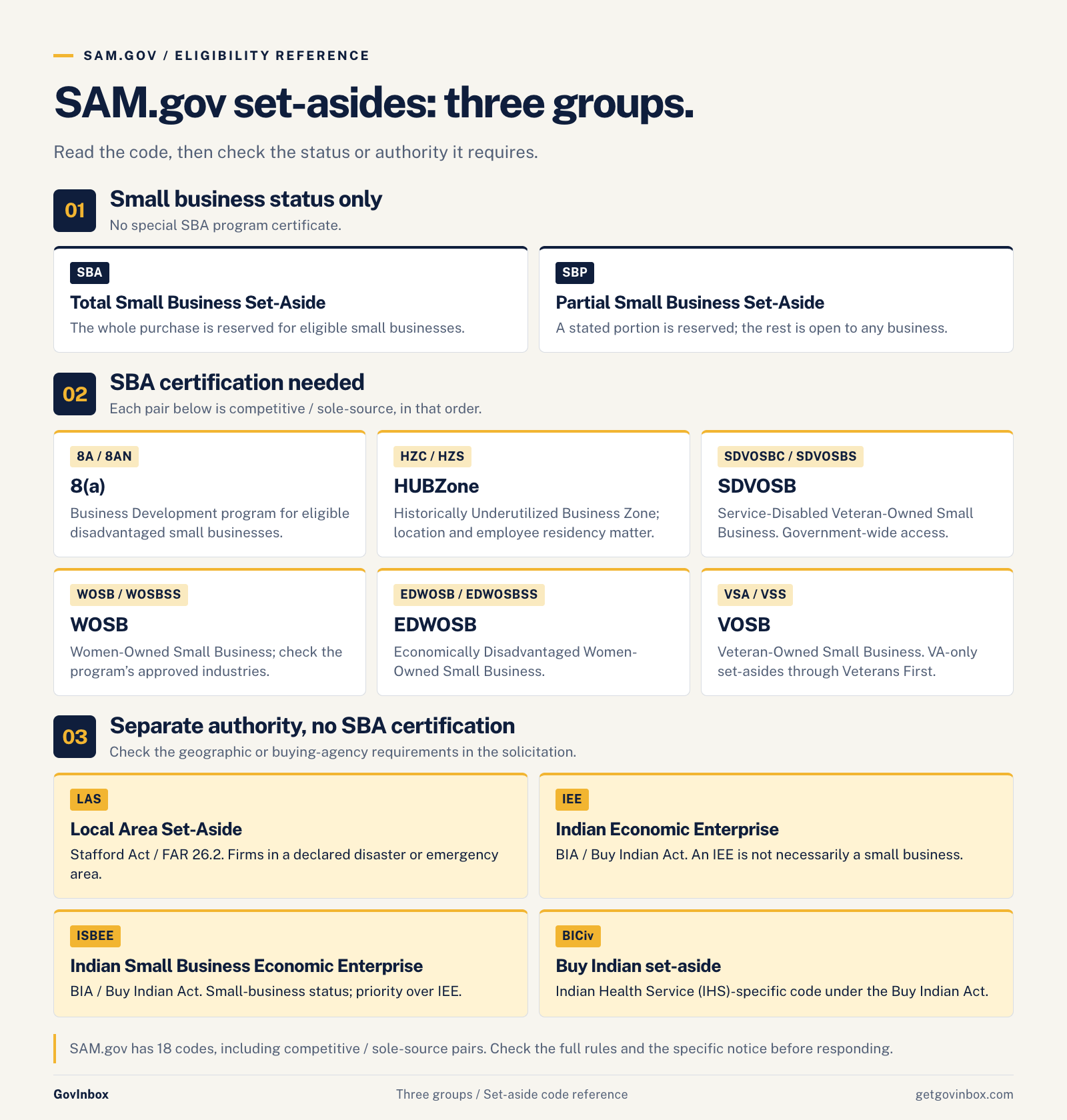
SAM.gov lists set-aside codes in three groups. Two need only small business status: total and partial small business set-asides. Six need SBA program status: 8(a), HUBZone, SDVOSB, VOSB, WOSB and EDWOSB. A third group runs under separate laws with no SBA certification: Local Area set-asides for disaster areas, and Buy Indian set-asides from the Bureau of Indian Affairs and Indian Health Service.
To understand a set-aside, start with the buyer's decision.
How the buyer chooses the lane
A contracting officer, the person allowed to buy for the agency, first works out what the agency needs. The officer then researches which businesses can do the work.
That research may include past purchases and responses to a sources-sought notice, an early request for information from possible suppliers.
For many purchases, the decision turns on the "rule of two." The officer expects offers from at least two capable small businesses and expects a fair market price. The rules depend on the purchase method and value; required government supply sources can also affect the decision. Read the federal set-aside rule.
Above the government's simplified purchasing limit, officers must consider the special small-business programs before a total or partial small business set-aside. There is no fixed ranking among those programs. Market research helps the officer choose. Read how the programs fit together.
Your size and certifications can make your firm eligible for a lane. The buyer decides whether to use that lane for the contract.
Two lanes need only small business status
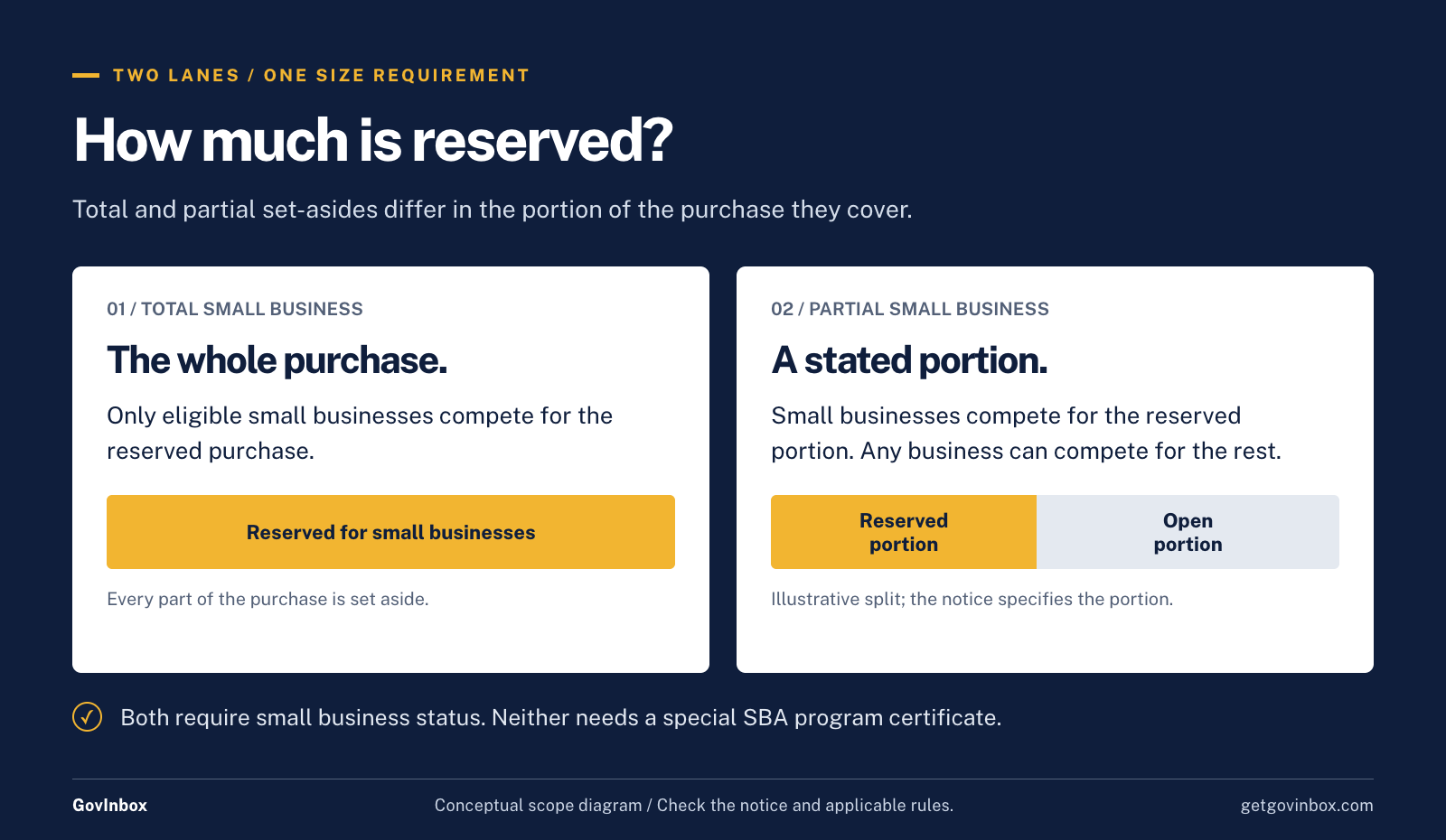
A total small business set-aside reserves the whole purchase for eligible small businesses. This is the broad, common starting lane.
A partial small business set-aside reserves only a stated portion of a purchase for small businesses. Any business can compete for the rest. An officer may use one when a total set-aside doesn't fit but part of the work does. Read the partial set-aside rule.
Neither lane requires a special SBA program certificate. You represent your business as small, meaning you state that it meets the applicable size rules.
"Small" has a specific meaning here. Each industry code has a size standard, a limit based on revenue or employee count. Your business must meet the limit for the code assigned to that purchase. Related businesses may count toward your size, too. See SBA's size guidance.
An active SAM.gov registration is part of getting ready. It does not settle every eligibility question.
Six lanes need SBA program status
These six lanes require the right program status, plus small business status for the notice's code. Treat the descriptions below as a first screen:
- 8(a): SBA's business development program for eligible disadvantaged small businesses. Individually owned applicants must prove social and economic disadvantage. Some qualifying entity-owned firms have different rules.
- HUBZone: Historically Underutilized Business Zone, a program tied to where the business operates and where employees live. A qualifying address alone does not qualify the firm.
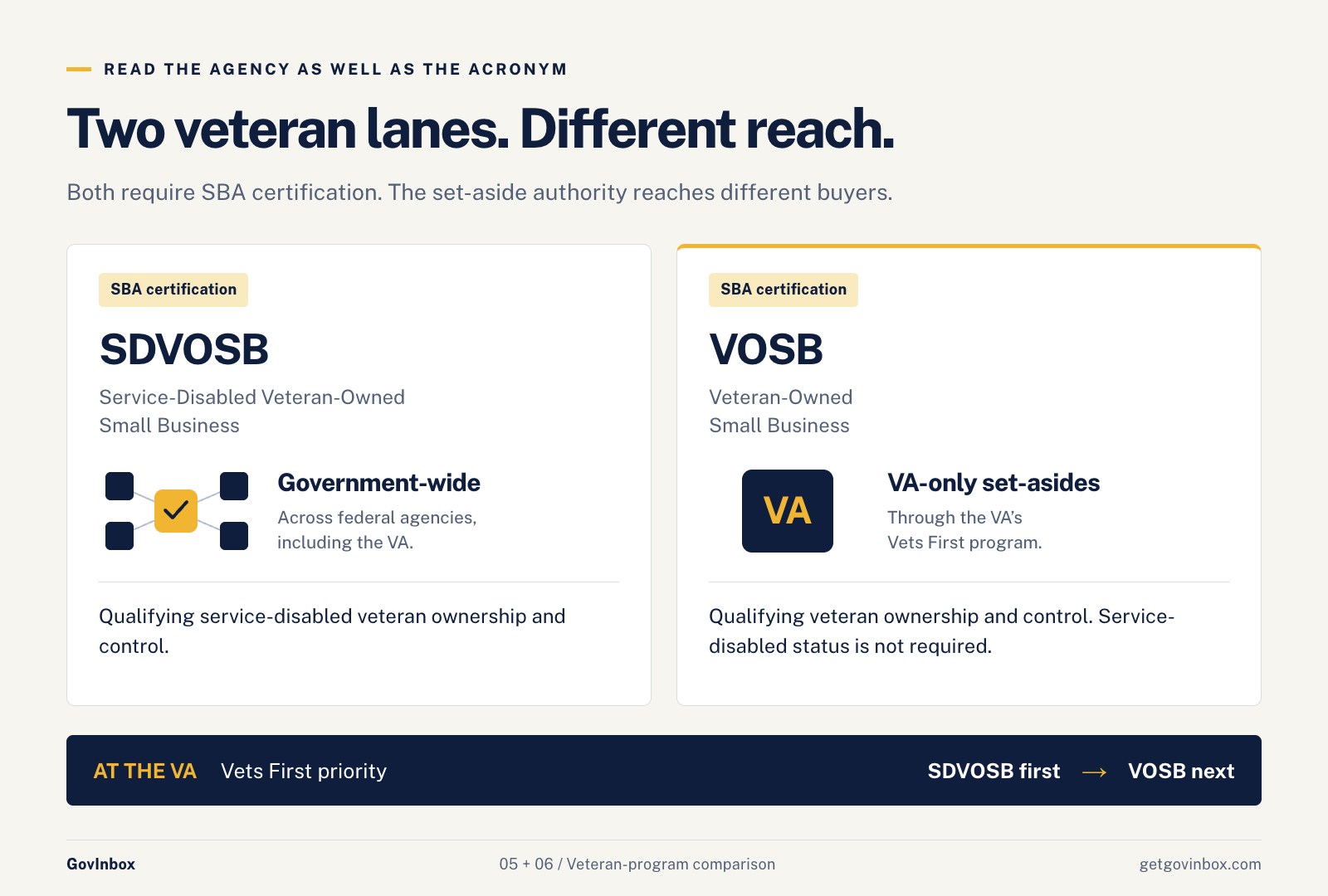
- SDVOSB: Service-Disabled Veteran-Owned Small Business. The business needs SBA certification based on qualifying ownership and control. Agencies across the government use these set-asides.
- VOSB: Veteran-Owned Small Business. A separate SBA certification for firms owned and controlled by veterans; service-disabled status is not required. VOSB set-asides are used by the VA, whose Vets First program gives priority to SDVOSBs first, then VOSBs.
- WOSB: Women-Owned Small Business. Certified firms can pursue these set-asides in industries approved for the program.
- EDWOSB: Economically Disadvantaged Women-Owned Small Business. This adds financial eligibility tests to the WOSB requirements.
SBA explains the 8(a), HUBZone and women-owned programs and the veteran-owned programs. A business can qualify for more than one program. A certified firm can still compete in total and partial small business set-asides when it is small for the notice's code.
Separate authority, no SBA certification
Two more set-aside types run under their own laws:
- Local Area: Used after a Presidential disaster or emergency declaration. The contracting officer may limit competition to firms that reside or do business primarily in the affected area, and may further restrict it to small businesses there. Authority: the Stafford Act, FAR 26.2.
- Buy Indian: Contracts from the Bureau of Indian Affairs and Indian Health Service reserved for Indian-owned businesses under the Buy Indian Act. SAM.gov shows these as IEE (Indian Economic Enterprise), ISBEE (Indian Small Business Economic Enterprise, which gets priority), and BICiv (the IHS-specific code). Qualifying firms represent their status with the offer; there is no SBA application.
Competition and sole-source awards
A competitive set-aside asks eligible firms to submit offers. The agency evaluates them under the stated rules.
A sole-source award goes to one eligible firm under specific legal authority. The officer still has to meet the program's conditions and support the price. Certification gives you access to possible awards; it does not promise one.
Read a sole-source notice's response instructions before treating it as an open bidding opportunity.
Which lanes have work?
Use that breakdown to see which of these lanes have recent notice volume. Then narrow it to the work you sell. A program with many notices nationwide may have little relevant work in your area.
Notice counts measure postings. They do not measure your chance of winning.
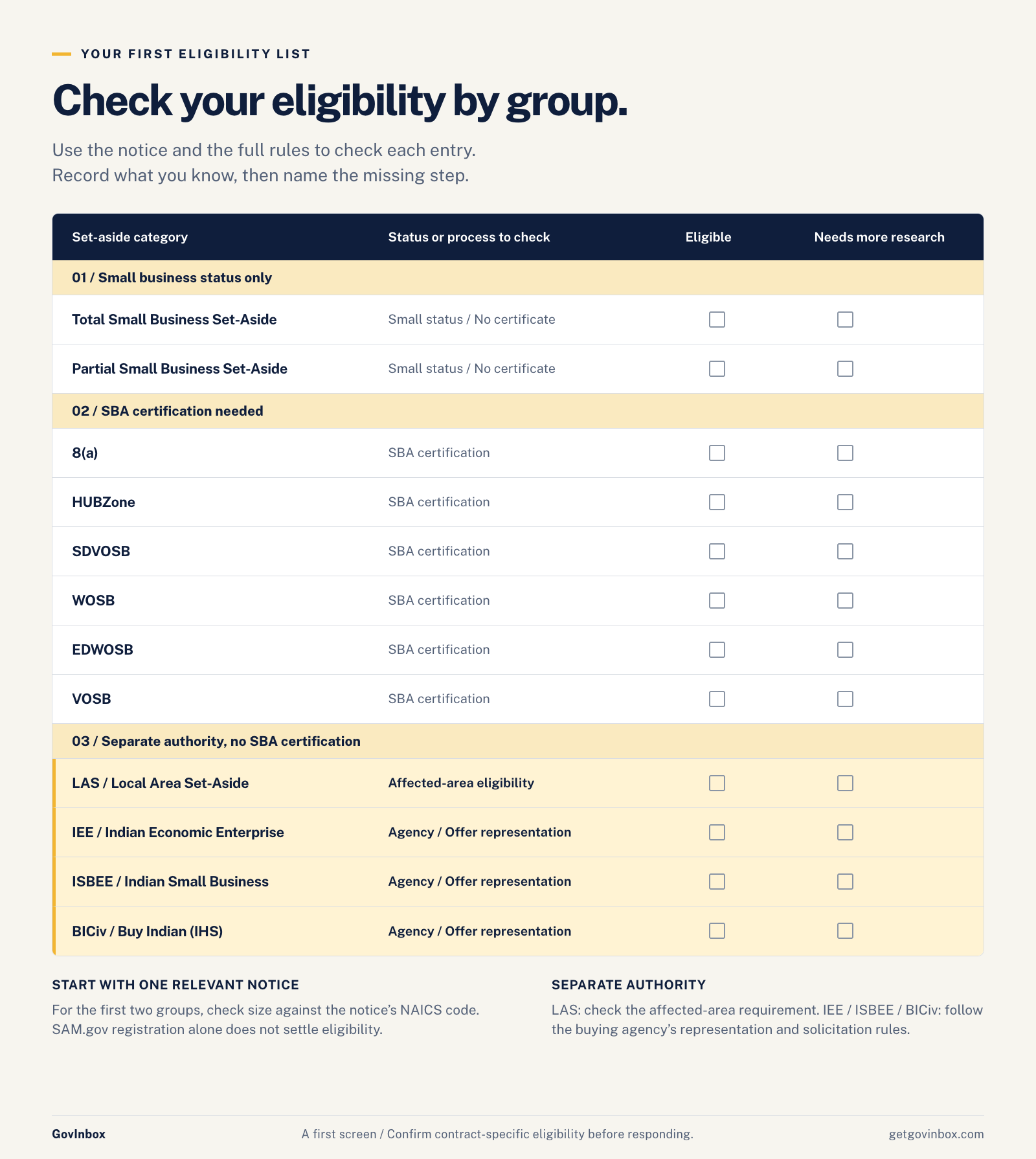
Make your first eligibility list
Go through each lane. Mark each one as "eligible" or "needs more research." For the second group, note whether certification is the missing step. For total and partial set-asides, size is the main question. Check your size against one notice for work you can perform.
If a special program looks possible, read how set-aside certification works. If you are a service-disabled veteran, use the SDVOSB eligibility self-check next.