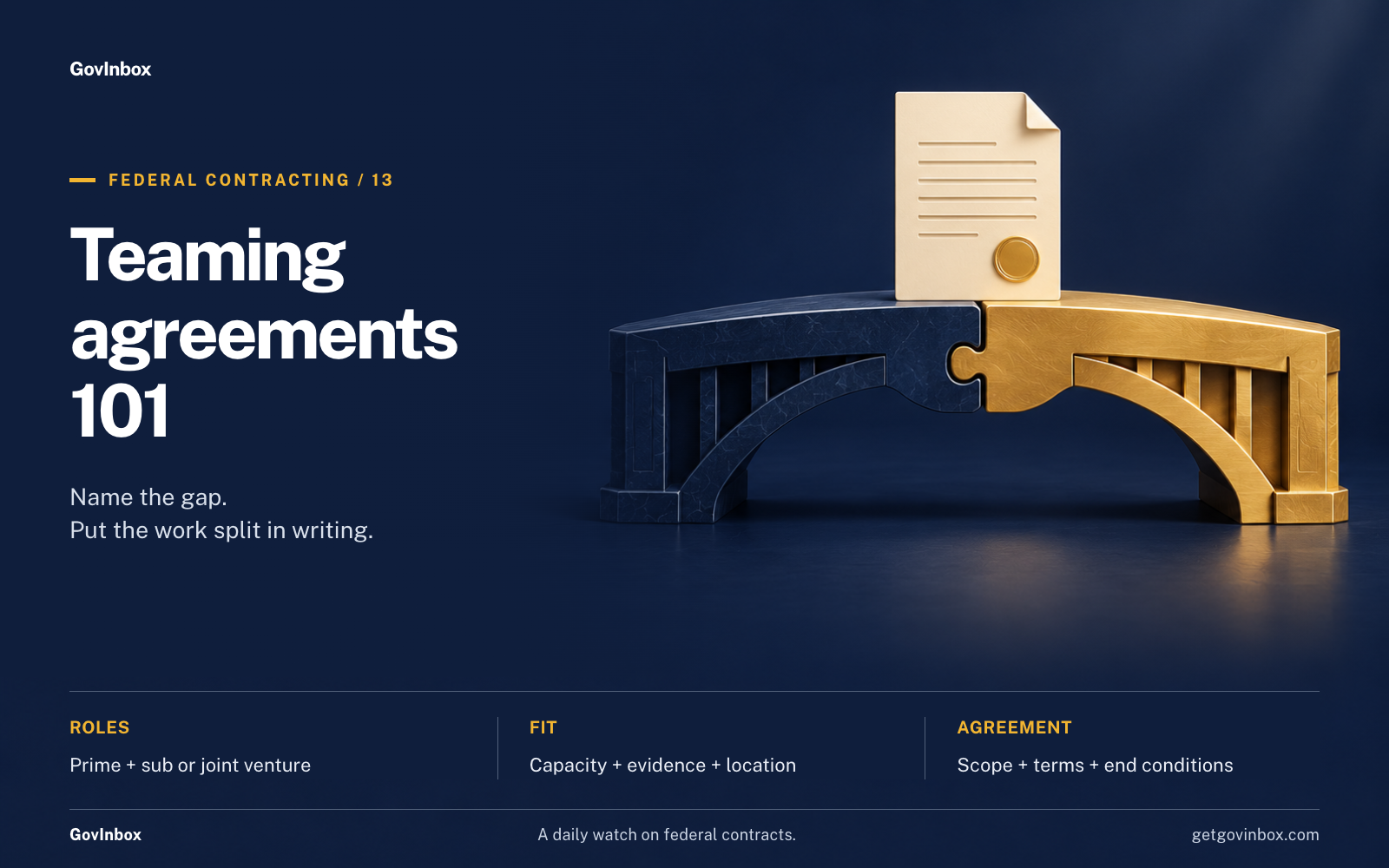
Teaming agreements 101: when to partner instead of prime
Published
The opportunity fits your skills. One part of the job does not.
You might need staff you cannot hire in time. Or the buyer wants experience your company has not earned yet. A partner can help, provided the arrangement meets the solicitation’s rules and gives each company a clear job.
Start by naming the gap. “We should team” is too vague to guide a useful conversation.
Decide who holds the government contract
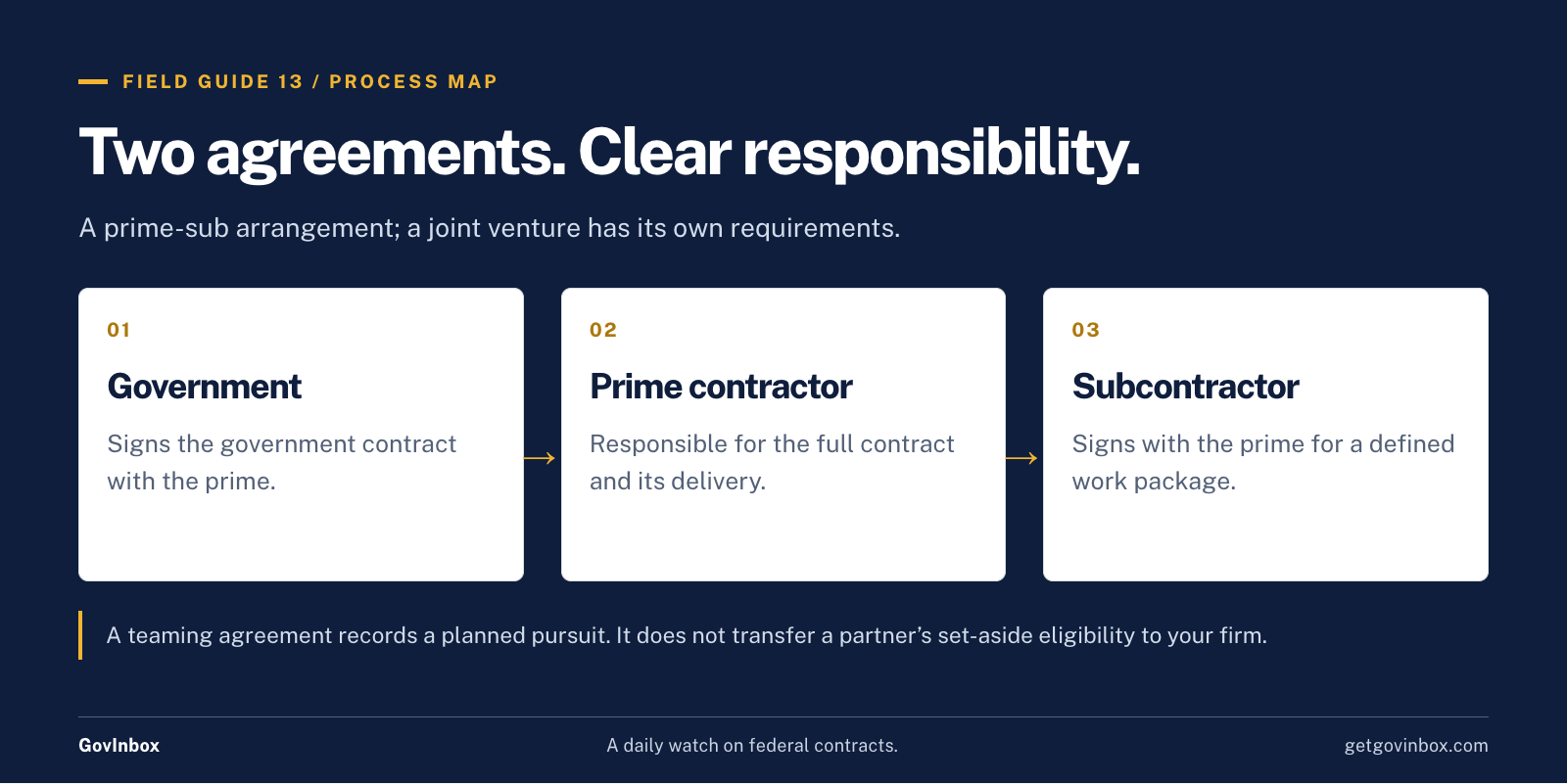
The prime contractor signs the contract with the government and remains responsible for delivery.
A subcontractor signs an agreement with the prime to perform part of that work. The sub’s customer is usually the prime, even when its employees work at a federal site.
A teaming agreement records how companies plan to cooperate on a specific pursuit. It may cover proposal work and the intended subcontract after an award. Federal contracting rules recognize both prime-sub arrangements and joint ventures, arrangements in which firms combine to pursue work together. Federal rules define contractor teams.
Choose the role based on who can manage the whole contract. A firm with a narrow, well-defined service may be better placed as a sub on a larger job.
Match the partner to a real gap
Write down exactly what you need.
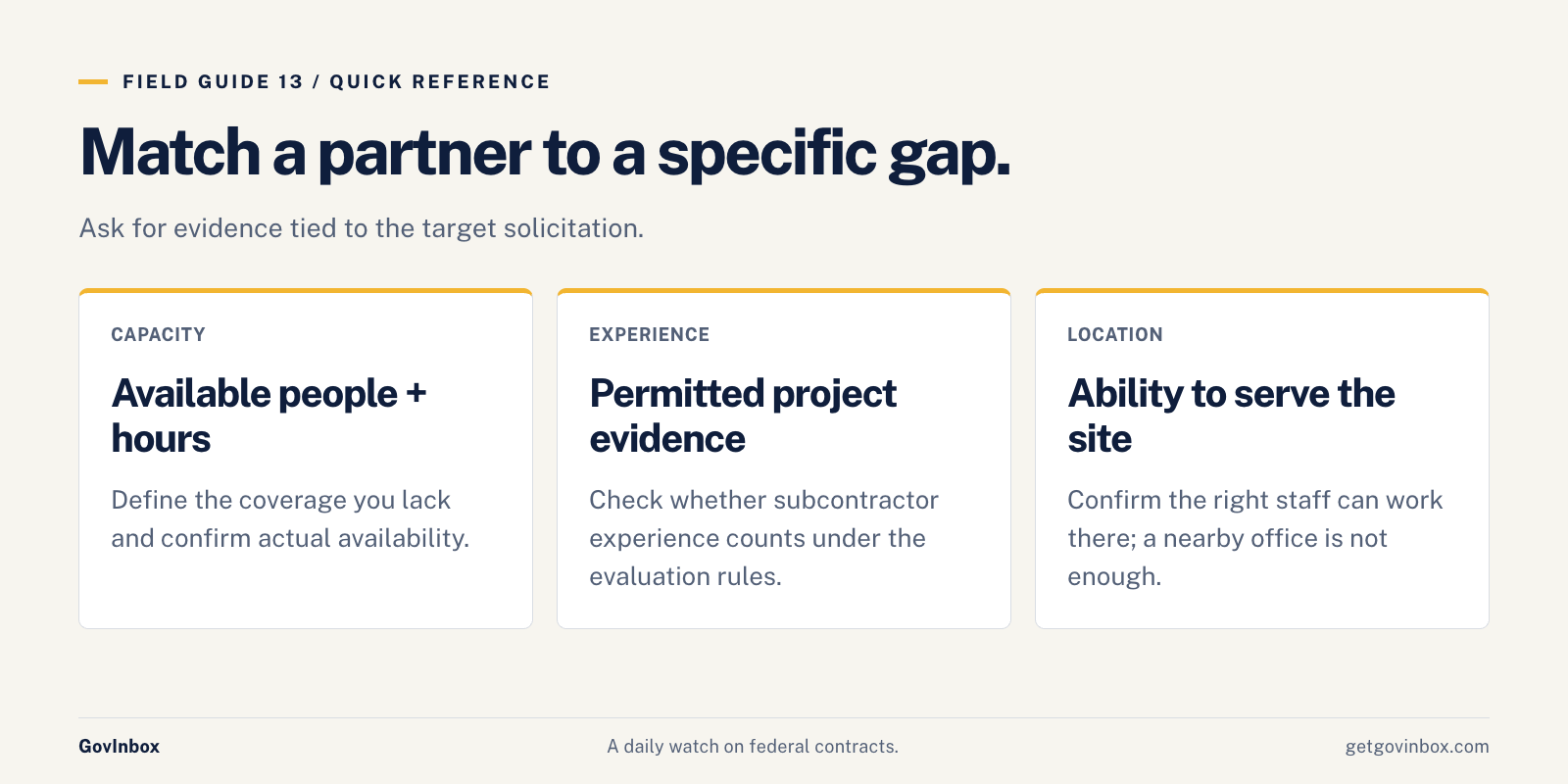
For a capacity gap, define the work hours or coverage you cannot supply. Ask the partner to confirm actual availability.
For an experience gap, compare its prior projects with the evaluation rules, the standards the agency uses to judge responses. Check whether the solicitation permits subcontractor experience to count. An impressive project outside those rules may add little to the proposal.
For a location gap, confirm that the partner can work where the agency needs it. A nearby office alone does not prove the right staff will be available.
Also ask what you contribute. A clear work package makes the relationship easier to price and explain.
Set-aside rules still apply
A set-aside is a contract reserved for businesses that meet specified requirements. A teaming agreement does not transfer a partner’s eligibility to your company.
If you intend to prime, verify that your business qualifies. Check limitations on subcontracting, rules that restrict how much covered work can be passed to other firms. The rules vary by contract type and by the status of the subcontractor. SBA’s regulation explains those limits.
A joint venture has separate requirements. Treat it as its own contracting decision, with a review of the relevant program rules. A last-minute document does not cure an eligibility problem.
Put the work split in writing
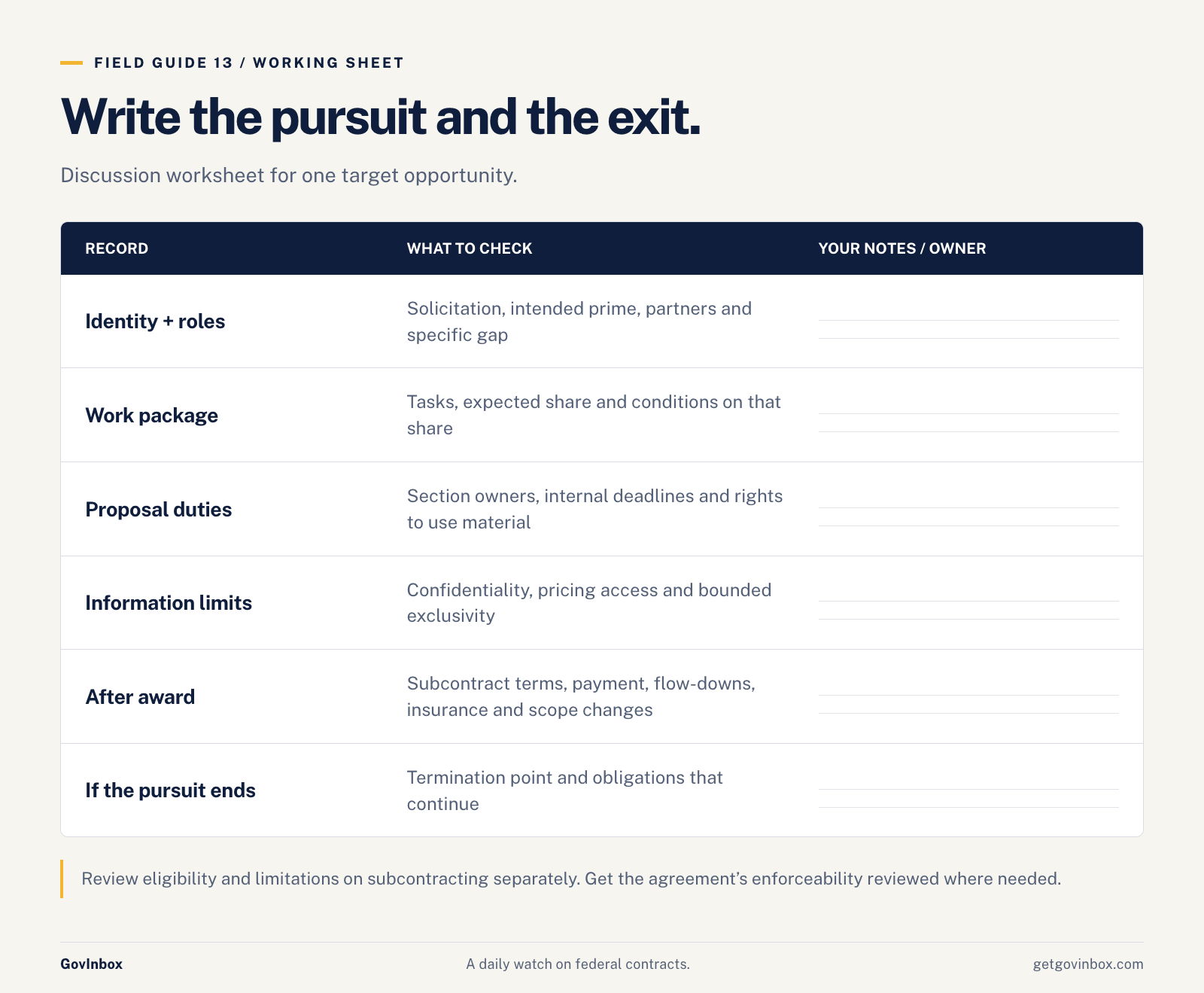
Name the target solicitation and each company’s role.
Define the proposed work package. Explain whether the expected share depends on award scope or government approval. A promise of a percentage without a description of the work leaves room for trouble.
Record who writes each proposal section and who can use the material. Set internal deadlines early enough for the prime to review everything.
Address confidential information and pricing access. Define any exclusivity, a restriction on working with other teams, by pursuit and duration. A broad restriction may tie up your firm longer than you intended.
Plan for the award and for a loss
If the team wins, how does the planned subcontract become final?
Review payment timing and invoicing requirements. Identify flow-down clauses, government contract terms the prime must pass into the subcontract. Ask about insurance and access requirements that could change your costs.
Address who owns work products and how changes to scope will be handled.
If the team loses or the pursuit is canceled, define when the agreement ends and which obligations continue. A lawyer familiar with government contracting can help assess whether the promised work and other terms are enforceable.
Your target-opportunity checklist
Before signing:
- The gap we need to fill is specific.
- The proposed prime can manage the whole contract.
- Our work package and expected share are written down.
- The solicitation permits the evidence we plan to use.
- Eligibility and subcontracting limits have been reviewed.
- Proposal duties and internal deadlines have owners.
- Confidentiality and exclusivity terms have clear limits.
- Payment, required clauses, and award conditions are understood.
- The agreement explains what happens if the pursuit ends.
Write a short work-split proposal for your target notice today. Use it to start the partner discussion before either firm spends time writing the bid.