Subcontracting: finding work under someone else’s prime
Published
You can perform federal contract work without holding the government’s contract yourself.
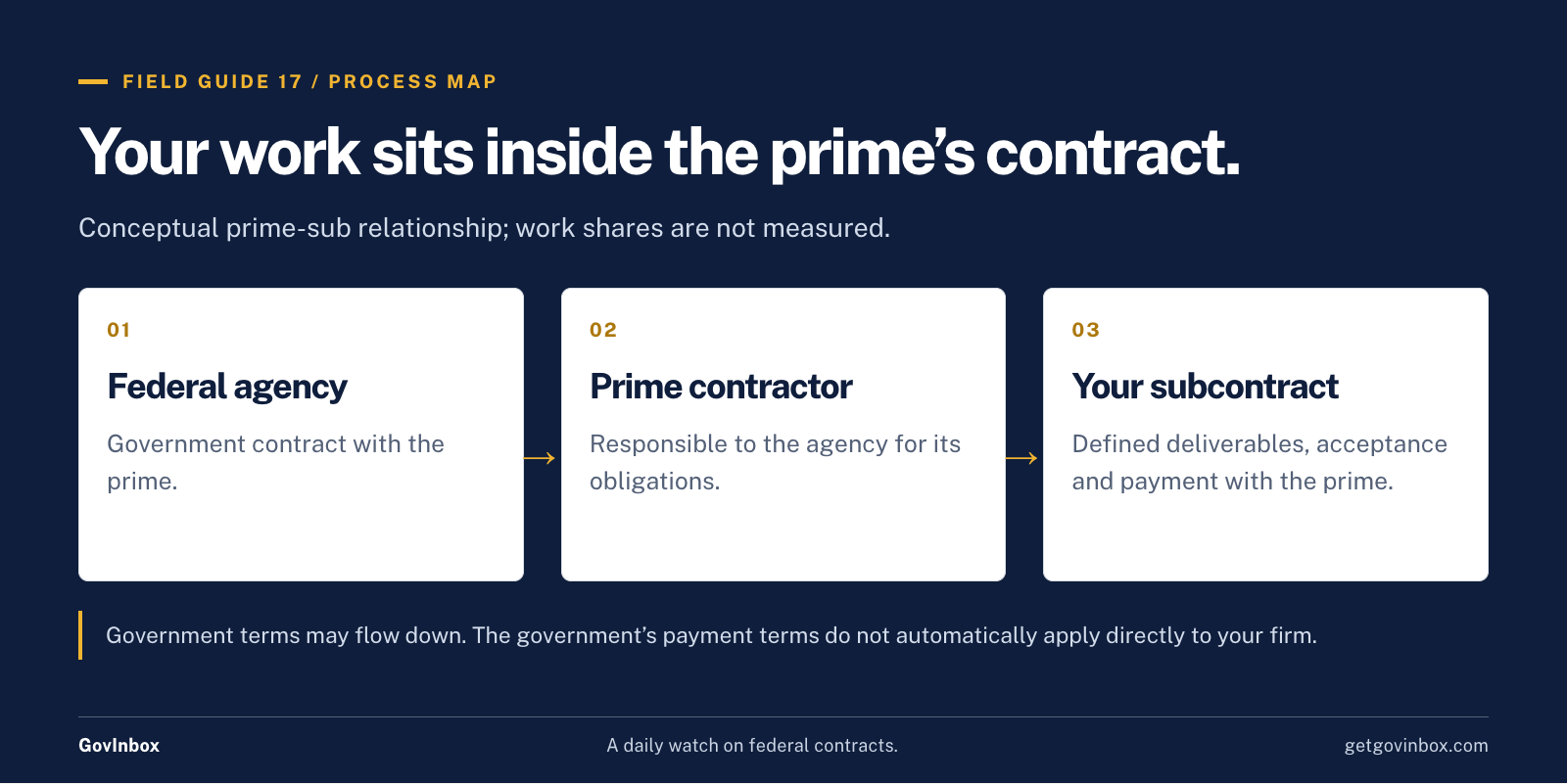
As a subcontractor, you sell a defined part of the job to the prime contractor, the company that signs the government contract. The prime manages its obligations to the agency. You manage the work promised in your subcontract.
This route can suit a new firm with a useful service and limited capacity for a larger contract. It still takes sales effort and a workable agreement.
Understand who your customer is
Your customer is usually the prime. That matters when you discuss scope or payment.
The government’s instructions may affect your work through flow-down clauses, terms the prime must pass into the subcontract. Ask which terms apply before giving a final price.
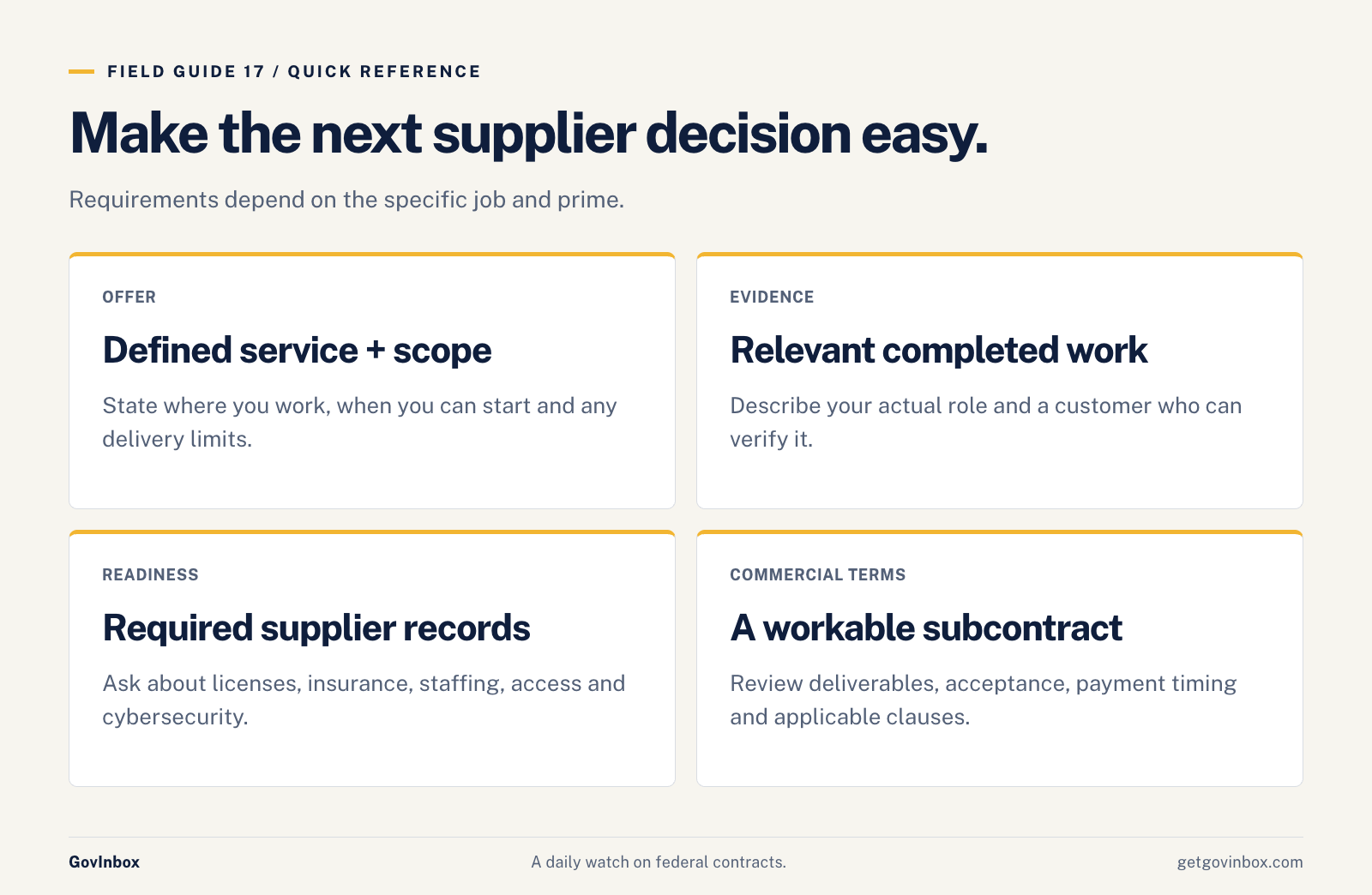
Your agreement with the prime should define deliverables, the outputs you owe, and how the prime accepts them. Check payment timing and any conditions that could delay payment.
Do not assume the government’s payment terms apply directly to your firm. Read what you are signing.
SBA’s prime and subcontracting guide explains the roles.
Offer a work package a prime can use
“We can help with anything” gives a prime little to evaluate.
Name a specific service you can deliver. Explain where you work and when you could start. State any limit that affects the job.
If you handle a specialized repair, describe the equipment or systems you can service. If you provide training, describe the audience and the work you would take off the prime’s plate.
Support that offer with evidence. A completed commercial project may help the prime assess you, even when it is not federal work. Be clear about your role and who can verify it.
Your small-business status can be relevant. It does not replace the need to perform.
Know what primes may check
The subcontract’s requirements depend on the job.
A prime may need proof of a license or insurance. It may ask about staffing and past performance, meaning how well you handled previous work.
For some jobs, security access or cybersecurity requirements affect whether you can start. Find those requirements early. Supplier onboarding, the prime’s process for approving a new vendor, can also take time.
Ask what information is needed for the next decision. A completed supplier profile may put you in a database without creating an order.
Understand subcontracting goals
Certain federal prime contracts require a subcontracting plan, a written plan for using small businesses with goals by business category.
Those goals create a reason for primes to look for suitable small firms. They do not guarantee your company a share of the work.
SBA maintains a directory of prime contractors with subcontracting plans. Use it to identify firms to research, then check their current supplier requirements.
This differs from a small-business set-aside, a competition reserved for qualifying firms. A prime on set-aside work may also subcontract, but separate rules limit how it can divide the work. Ask how your proposed role fits the contract.
Search with the prime’s job in mind
Look for primes performing the kind of work you can support.
Review the prime’s official website for supplier registration and subcontract notices. If it names a small-business liaison, a contact responsible for small-business supplier relationships, follow the stated contact process.
Use the contract or project name when introducing your service. Explain the specific work package you can cover.
Keep a contact log. Record the service offered and the next agreed step. Avoid treating every large contractor as a suitable lead.
Three places to look this week
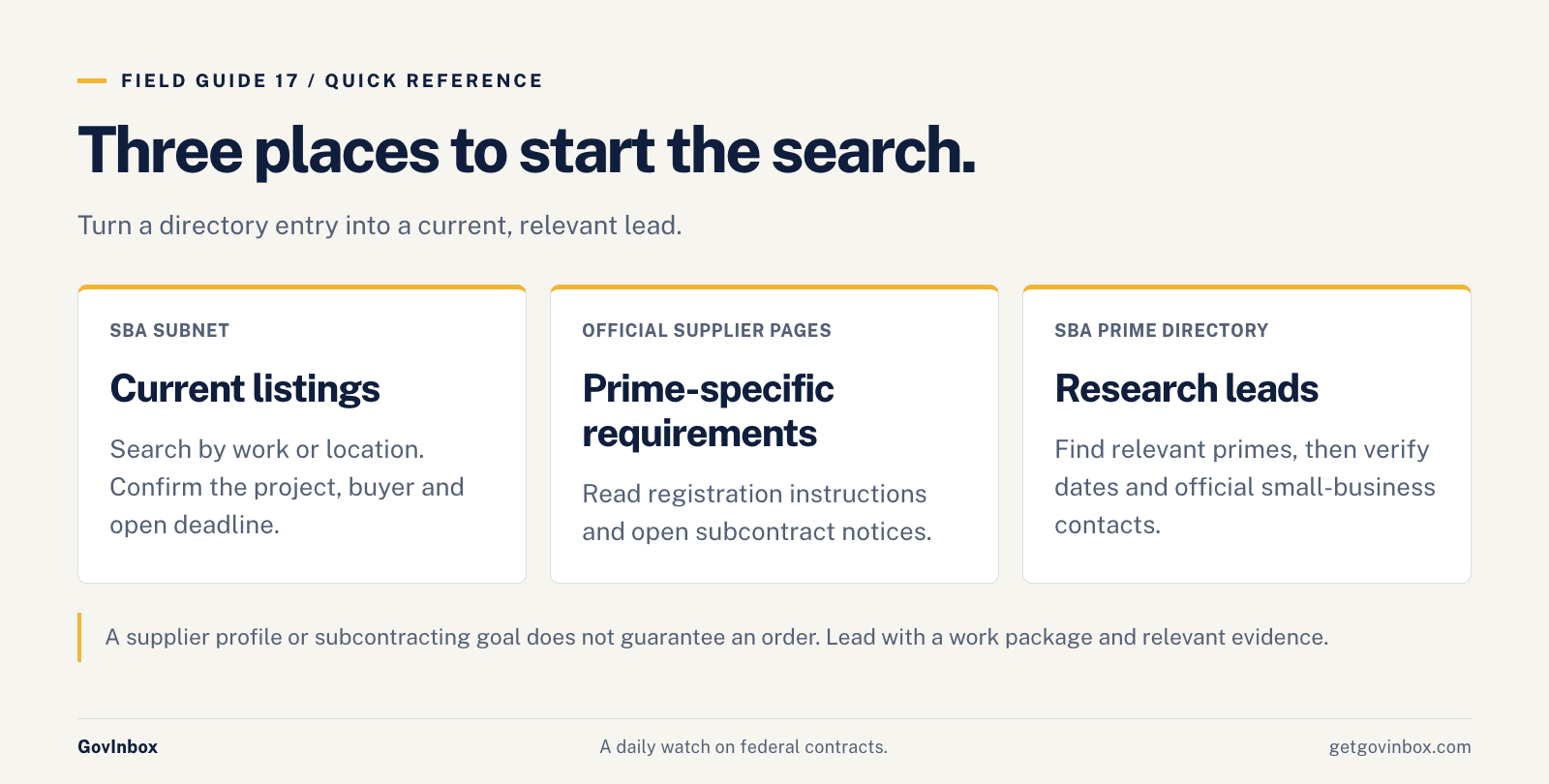
1. SBA’s SUBNet listings. Browse current subcontract opportunities by keyword or location. Read the full posting and contact the listed buyer. Confirm that the project is federal and that the deadline is current.
2. Prime contractors’ official supplier pages. Pick firms doing work that fits your service. Read their registration requirements and open subcontract notices. Prepare the evidence they request before submitting a profile.
3. SBA’s prime-contractor directory. Filter the directory for relevant work or agencies. Use the results to find each prime’s official supplier page or small-business contact. Check the record’s dates before assuming the listed contract is still active.
Choose one live lead from these places. Write a short introduction that names your work package, gives relevant evidence, and asks for the next supplier step.