SDVOSB explained: who qualifies and what it unlocks
Published
If you are a service-disabled veteran who owns a business, SDVOSB certification is worth checking.
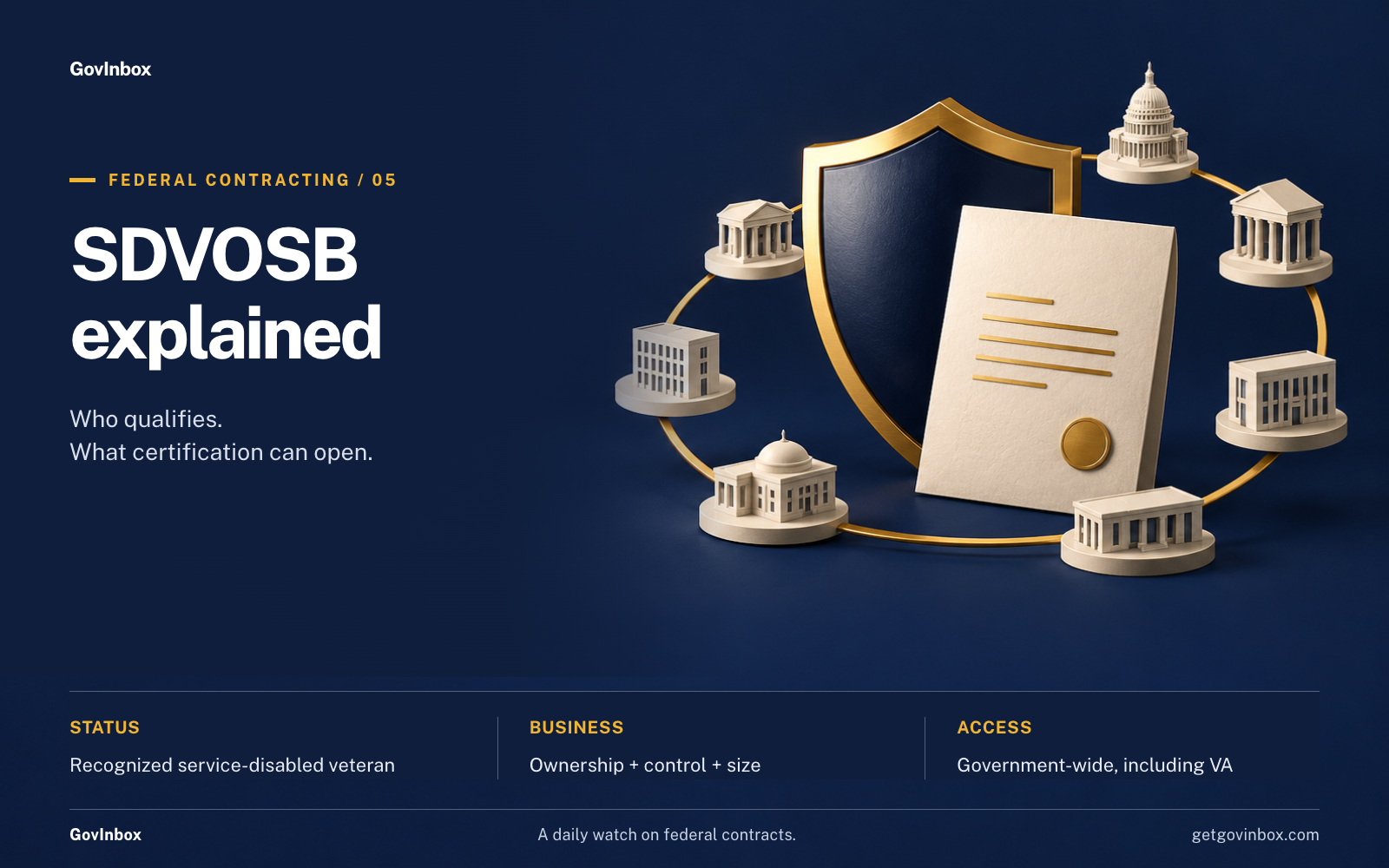
SDVOSB means Service-Disabled Veteran-Owned Small Business. Federal certification can make your firm eligible for contracts reserved for that group across the federal government.
The review looks at the business as well as the veteran. A qualifying veteran must have the required ownership and real control of the company.
GovInbox follows this lane closely.
Your firm's eligibility depends on its own records.
Start with recognized veteran status
SBA checks veteran and service-disabled status with the Department of Veterans Affairs, usually called the VA.
You need recognized service-disabled veteran status. A disability unrelated to military service does not meet that requirement by itself.
If the VA's records do not match what you believe your status should be, resolve that with the VA. The certification program cannot create or change your veteran designation. Read the official status guidance.
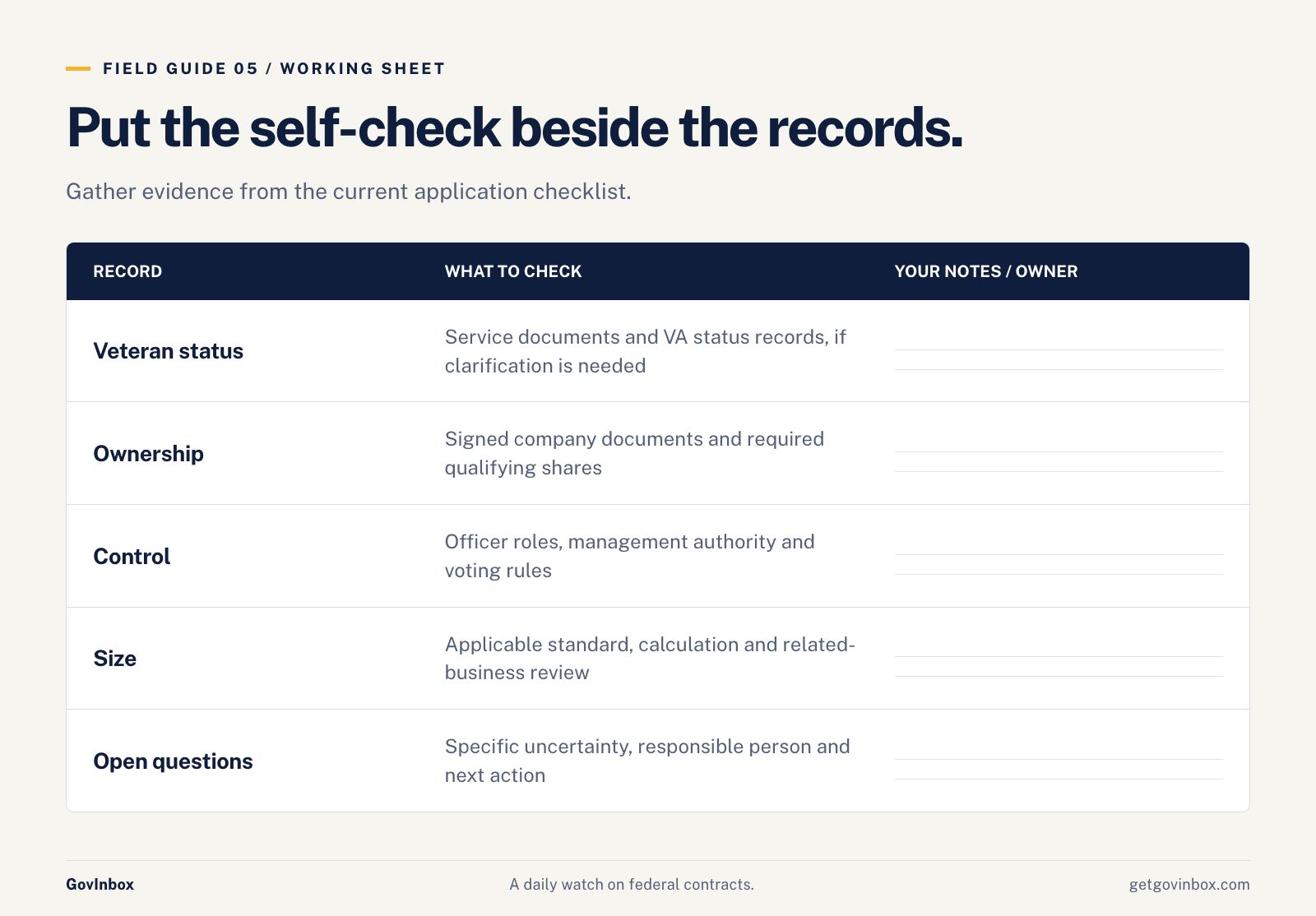
Keep your service documents and VA records available while you prepare the application.
Check who owns the business
One or more qualifying service-disabled veterans must own at least 51% of the business, with ownership rights that meet SBA's rules.
The ownership must be "direct," which generally means the veteran owns the interest personally. It must also be "unconditional," meaning arrangements cannot shift its benefits to someone else. SBA's rules have specific exceptions. Read the ownership rule.
Check the actual company documents. An informal understanding between owners will not fix an agreement showing different ownership.
For an LLC, a limited liability company, review each class of ownership interest. For a corporation, check its stock and voting rights.
Check who controls it
Control includes daily operations and long-term decisions. The qualifying veteran generally must hold the highest officer position and have the management experience needed to run the firm.
A veteran-owned percentage on paper can still leave control with someone else. Read who can make routine decisions and who can block them.
Outside employment also matters if it prevents the qualifying veteran from managing the business. SBA has specific exceptions, including certain arrangements for a veteran with a permanent and severe disability. Read the control rule.
If your agreement gives another owner a veto over ordinary business decisions, get that reviewed before applying.
Confirm the business is small
Your company must meet SBA's size requirements.
For a particular contract, check the size standard attached to its NAICS code, the industry code assigned to the purchase. Count related businesses when SBA's affiliation rules require it.
Certification does not settle the size question for every contract. The assigned code can have a different limit from the code you use for other work.
What certification opens
A competed SDVOSB set-aside limits offers to eligible firms in the program. The agency evaluates those offers under the solicitation, its formal request for offers. Read the competition rules.
An SDVOSB sole-source award goes to one eligible firm when the legal conditions are met. The buyer must support the firm's ability to perform and a fair price. These awards also have value limits. Read the sole-source rules.
You may pursue general small-business work as well, when you meet its requirements. Certification opens possible buying routes. You still need work that fits your company.
SDVOSB and VA-specific VOSB work
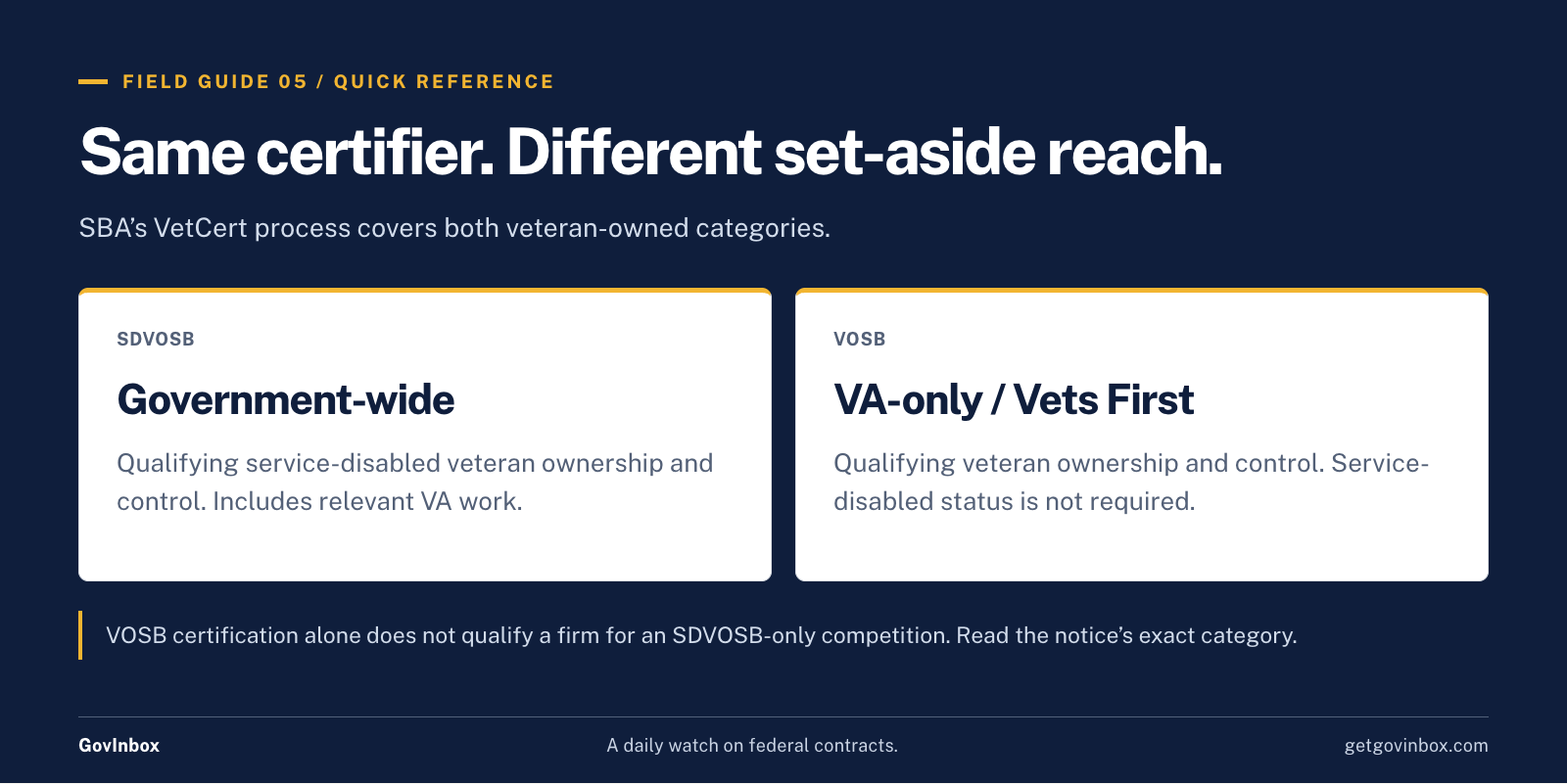
VOSB means Veteran-Owned Small Business. A qualifying veteran does not need service-disabled status for that certification.
Certified VOSBs have access to special set-aside and sole-source opportunities at the VA under its Vets First program. Certified SDVOSBs have a government-wide program and can also pursue relevant VA work. See SBA's program explanation.
Read the notice's exact category. A veteran-owned business should not assume it qualifies for an SDVOSB-only competition.
Use that mix to choose an agency to study. Narrow it to your service and the places where you can perform.
Check your eligibility on the official sites
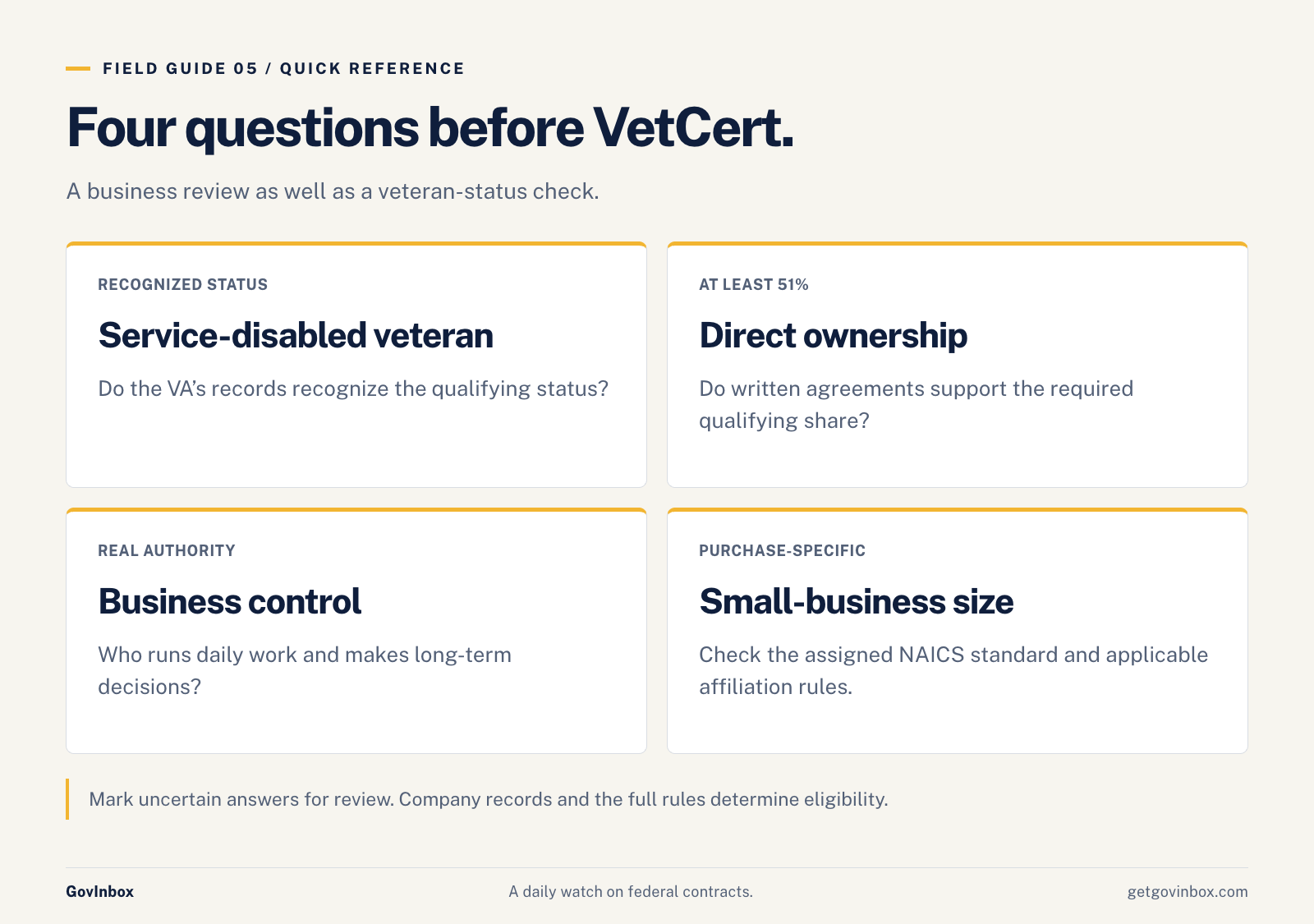
- Do the VA's records recognize the qualifying owner's service-disabled veteran status?
- Do qualifying veterans directly own the required share, under the written agreements?
- Do qualifying veterans control the firm in practice and under its voting rules?
- Do the qualifying veterans reside in the United States?
- Is the business small under the applicable SBA rules?
Mark any uncertain answer for review. This list is only a starting point. GovInbox does not decide eligibility. Certification decisions come from the official federal certification program, and its rules are the ones that count. Check every answer against the official rules on the government pages linked above. If everything checks out and you have a strong claim, open the official certification site to start your application and gather the documents on its current checklist.