SAM.gov registration: UEI, CAGE, and keeping your status active
Published
You found a federal contract that fits your business. Before you work on the response, check whether the government can award a contract to your company.
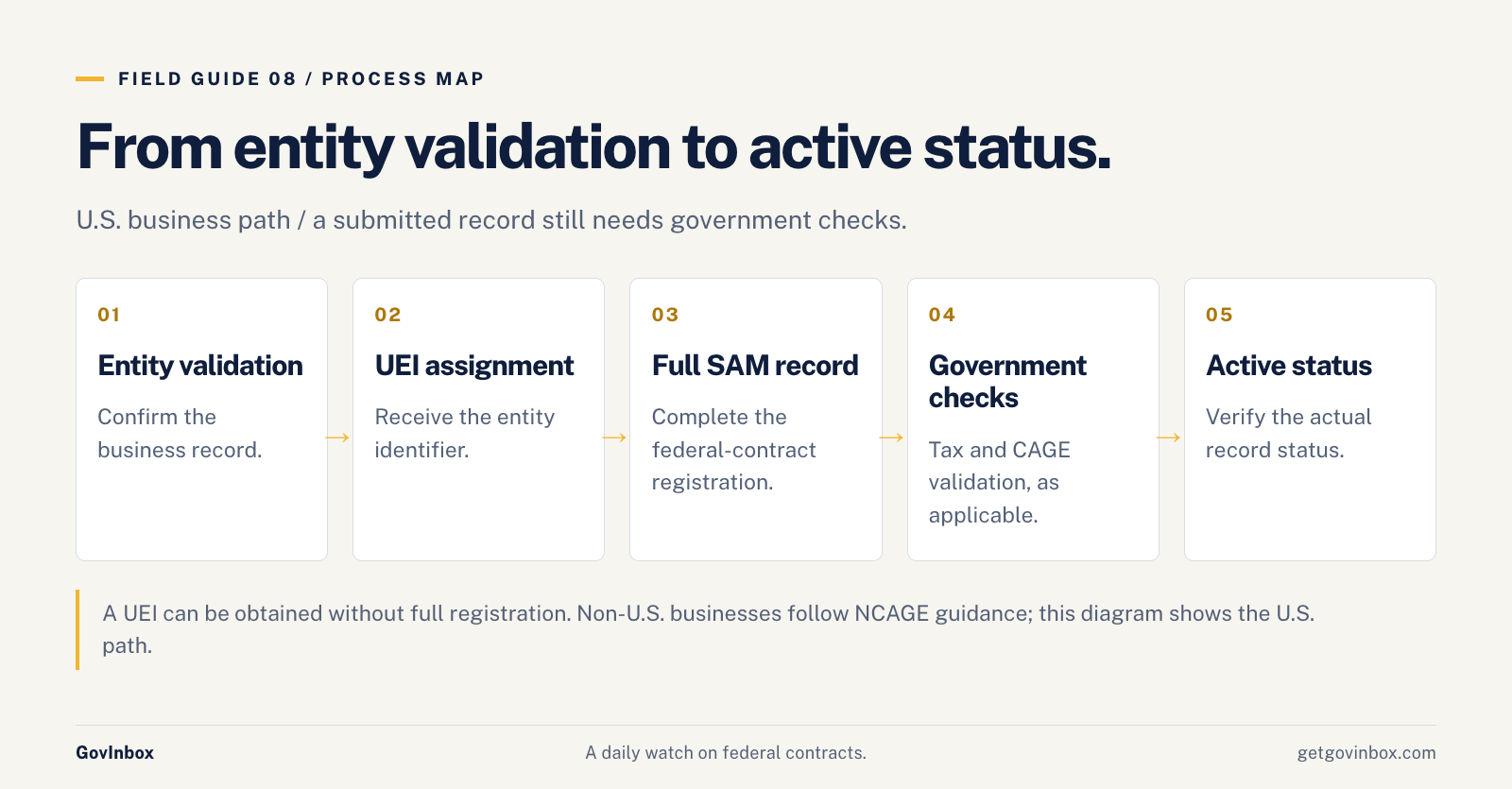
For most businesses bidding as a prime contractor, the company that signs the government contract, that starts with an active SAM.gov registration. Getting an identification number alone does not finish the job.
The process has a few connected parts. Here is what each one does and how to keep a paperwork delay from becoming a missed deadline.
Your UEI identifies your company
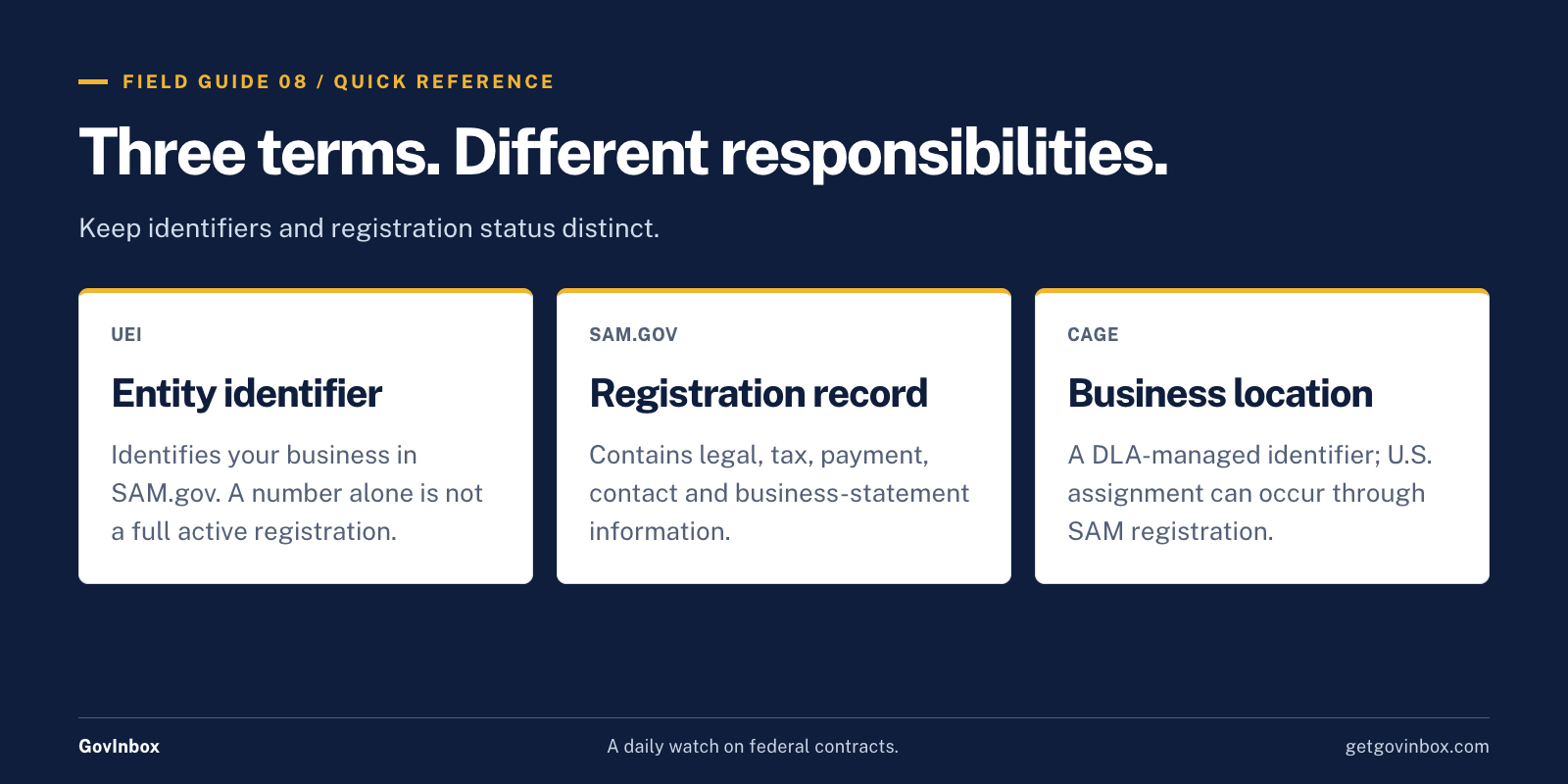
A Unique Entity ID, or UEI, is the identifier the government uses for your business in SAM.gov. You get it through SAM.gov after your entity, meaning your business or organization, is validated.
You can request a UEI without completing a full registration. That limited step may suit some purposes, but a UEI by itself does not make you ready to bid for most federal prime contracts. Choose the registration path for federal contracts and complete the required record. SAM.gov explains the registration options.
Search for an existing record before starting another one. If your company already has a UEI, use that record and resolve any access issue.
SAM.gov is the full registration
Your registration contains the information the government needs to identify your company and do business with it.
That includes your legal business name and tax information. You also provide payment details and business contacts. The representations and certifications section contains statements about your business and its compliance with applicable requirements. Read those statements before accepting them.
NAICS codes, short for North American Industry Classification System codes, describe your business’s industries. Pick codes that match work you actually perform. Adding a code does not give you a license or prove that you qualify as a small business for every contract.
Registration and renewal on SAM.gov are free. Use the official registration checklist to gather the required information before starting.
Your CAGE code connects another record
A Commercial and Government Entity code, or CAGE code, identifies a business location in a system managed by the Defense Logistics Agency.
For a U.S. business, the SAM.gov registration process can assign a CAGE code if one does not already exist. You usually do not need to treat this as a separate application before beginning SAM.gov registration. Respond if the agency asks you to confirm information. DLA explains how registration and CAGE assignment connect.
Businesses outside the United States follow a different process involving an NCAGE code, the international version of that identifier. Check the official guidance for your location.
“Submitted” and “active” mean different things
A submitted registration still needs government checks. Look for the record’s actual status.
Under the standard SAM registration provision, registration is required when you submit an offer or quotation and at award. The contract’s maintenance requirements also matter during performance. Check the provisions in your own solicitation, the government’s request for responses, for applicable exceptions or agency rules.
SAM.gov requires renewal every 365 days to keep the registration active. Set reminders early enough to fix validation problems before expiration. A renewal in progress is not proof that your record is active.
Mistakes worth checking first
Use your legal business name consistently. A brand name may differ from the name used in tax records.
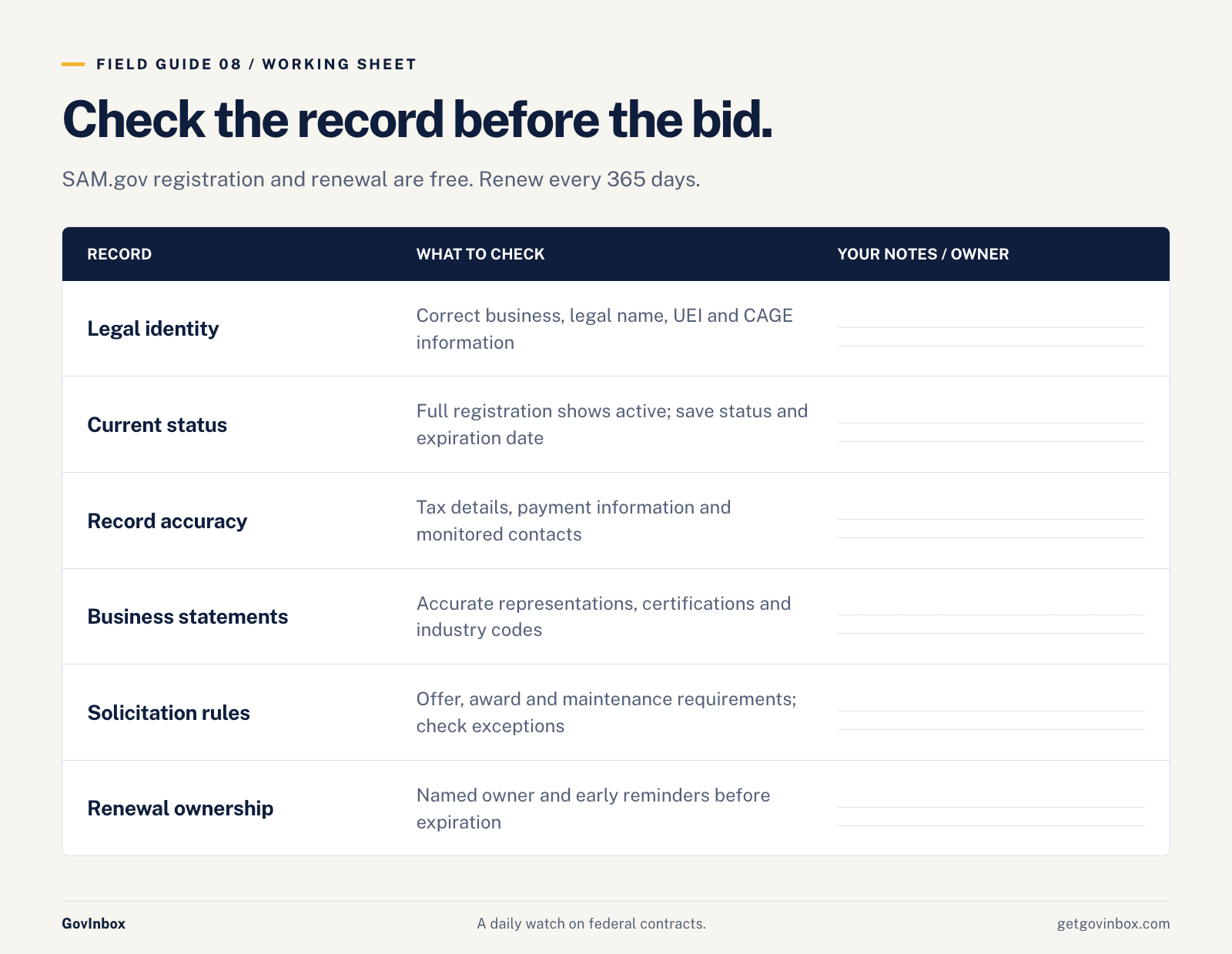
Check your physical address against the documents used for validation. Confirm that tax information matches the relevant IRS records. Make sure someone monitors the registration contact’s email, including the junk folder.
After a move or ownership change, review the whole record. One corrected field may leave another outdated.
Avoid waiting until a bid deadline to begin registration. The process can require follow-up, and submission does not guarantee immediate activation.
Your readiness checklist
Before preparing your next bid, confirm:
- The registration belongs to the legal business submitting the response.
- Your UEI is recorded correctly.
- Your full registration shows active status.
- Your CAGE information is correct for your business.
- Your tax details, payment information, and contacts are current.
- Your business statements and industry codes are accurate.
- You have checked the solicitation’s registration requirements.
- Someone owns renewal, with reminders set before expiration.
Open your SAM.gov record today. Save the status and expiration date in your bid folder, then name the person responsible for keeping it active.