RFP vs RFQ vs IFB: what the solicitation type tells you
Published
The government wants to buy something your company sells. Then you see a label: RFP, RFQ, or IFB.
That label gives you a starting point for understanding the response. It does not tell you the whole award method.
A solicitation is the government’s request for bids, proposals, or quotes. Whatever its label, read the submission instructions and evaluation criteria, the rules used to judge responses, before deciding how much writing or pricing work it needs.
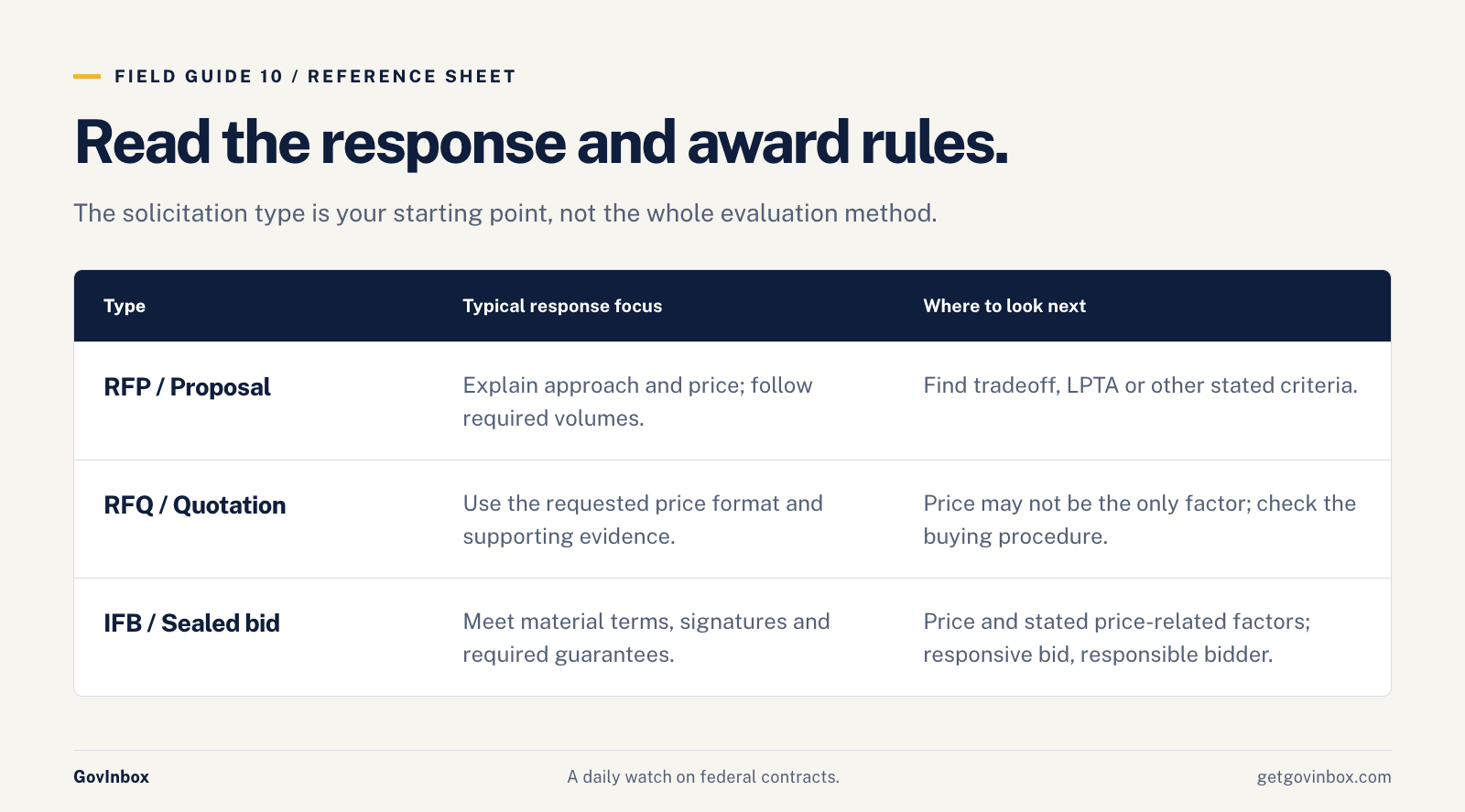
An RFP asks for a proposal
RFP means request for proposals. The agency asks you to explain how you would meet its needs and what you would charge.
Your response may need a work plan and evidence that your team can perform. Some RFPs ask for separate technical and price documents. Others use a shorter format. Follow the actual instructions rather than assuming every proposal needs a long narrative. Federal proposal rules explain what an RFP contains.
How does the agency choose?
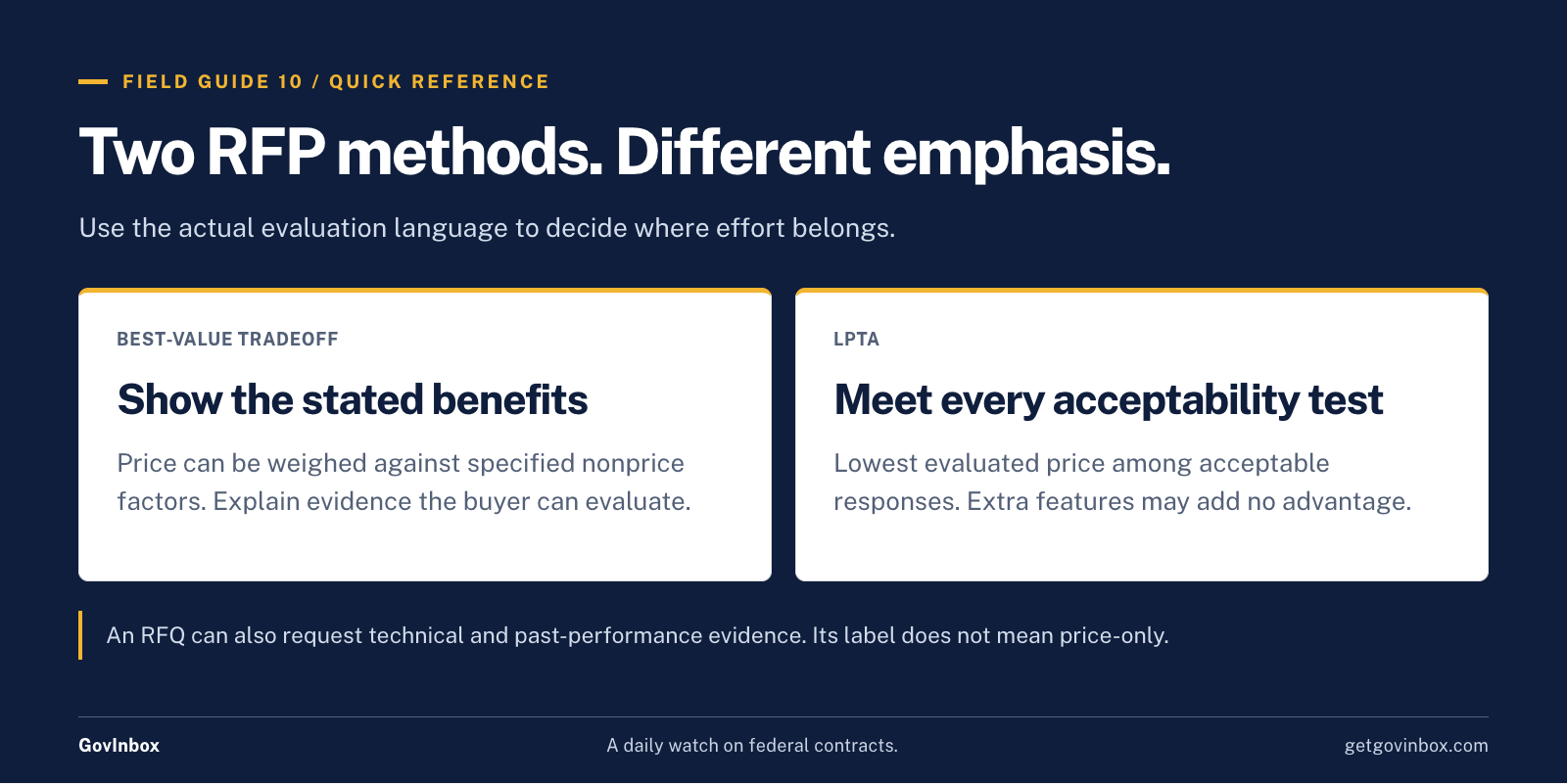
Look for a best-value tradeoff, a method that lets the agency weigh price against stated nonprice factors. Under that method, a higher price can win when the benefits justify the extra cost.
An RFP can also use lowest price technically acceptable, often shortened to LPTA. That means the agency selects the lowest evaluated price among responses that meet its stated acceptability standards. Extra features may earn you no advantage under that method. The Federal Acquisition Regulation explains both approaches.
Your response should follow the scoring rules. If staffing quality carries weight, show how your staffing plan meets the need. If the test is pass or fail, clearly show compliance with every required standard.
Do not assume you will get a chance to revise your proposal after submission.
An RFQ asks for a quote
RFQ means request for quotations. The agency asks what you would charge to provide the requested supplies or services, often with supporting information.
An RFQ can be brief. It can also require a technical approach or past-performance details, meaning evidence of how well you handled prior work. Its label does not mean price is the only factor.
Under simplified acquisition procedures, the rules used for certain less complex purchases, a quote generally does not form a contract by itself. The government can issue an order based on the quote, and the supplier’s acceptance establishes the contract. Federal quotation rules explain this distinction.
Orders under existing contracts have their own rules. Read the RFQ and the contract it uses.
For your response, complete the requested price format and identify what your price includes. Check delivery terms and any required supporting documents. A short quote still has to answer the whole request.
Avoid adding your standard commercial terms without checking whether they conflict with the government’s requirements.
An IFB asks for a sealed bid
IFB means invitation for bids. The agency states its requirements and uses sealed bidding, a process with a set bid opening and evaluation without discussions.
Award considers price and any stated price-related factors. The bidder must be responsible, meaning able to perform, and the bid must be responsive, meaning it meets the invitation’s material requirements. Federal rules describe sealed bidding.
Here, careful compliance and accurate pricing deserve your attention. Check signatures and required bid guarantees, which provide financial assurance when the invitation requires them.
A qualification that changes a material requirement can make the bid unacceptable. Do not assume a low price will cure that problem.
The title is only your first clue
A combined synopsis/solicitation is a notice that combines the public announcement with the request for responses. It can still ask for a quote or proposal.
A sources-sought notice asks the market who can do the work. It generally seeks information rather than an offer for immediate award. Read what the agency wants before sending a price.
Read your next notice with a pen
Before you start the response:
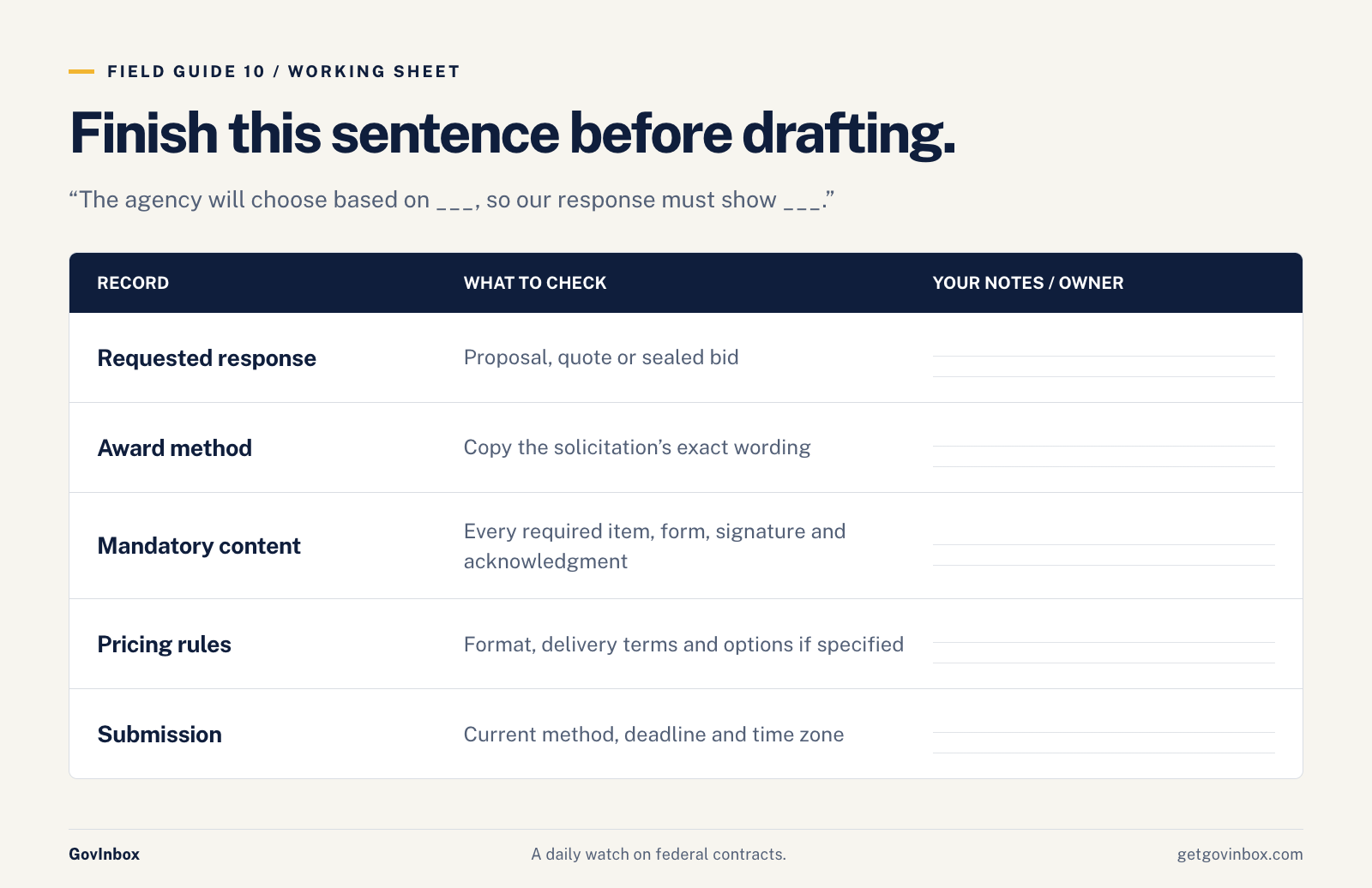
- Write down whether the agency wants a proposal, quote, or sealed bid.
- Find the award criteria and copy the stated method.
- Mark every mandatory response item.
- Check how price will be evaluated, including options if specified.
- Identify required forms, signatures, and amendment acknowledgments.
- Confirm the submission method and current deadline.
Then finish this sentence: “The agency will choose based on ___, so our response must show ___.” Use the solicitation’s words to fill the first blank and your evidence to fill the second.