How to read a Statement of Work without missing the trap clauses
Published
A job title can sound familiar. The work behind it may be much bigger than you expected.
The Statement of Work, or SOW, describes the work the government expects you to perform. Read it with your delivery costs beside you. Every required task needs someone to do it, and every deadline needs a workable schedule.
A costly clause may sit in an ordinary paragraph. The question is whether you understand the obligation well enough to price and perform it.
First, map the job
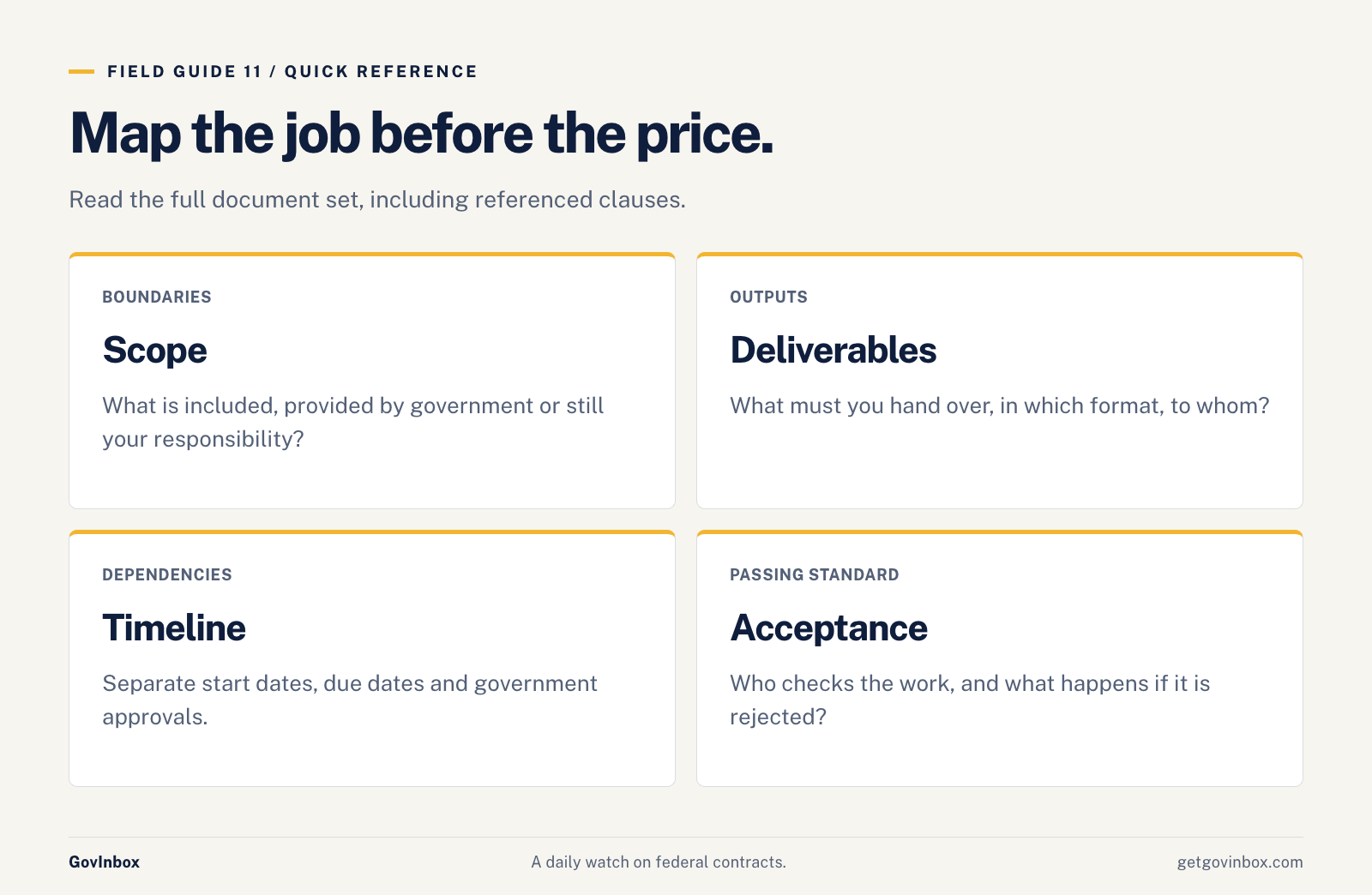
Start with the scope, meaning the boundaries of the work. What is included? What does the government provide? Which tasks remain your responsibility?
Next, find the deliverables, the outputs you must hand over. A deliverable might be a report or installed equipment. Write down the required format and who receives it.
Review the timeline. Separate the start date from later delivery dates. Note any task that depends on government access or approval.
Then find acceptance criteria, the standards the government uses to decide whether your work is complete. Who checks the work? What counts as passing? What happens if it is rejected?
Some notices use a Performance Work Statement, or PWS, which describes required results and performance standards. Federal performance-work rules explain that approach. Either way, you need a clear picture of the result you owe.
Watch vague deliverables
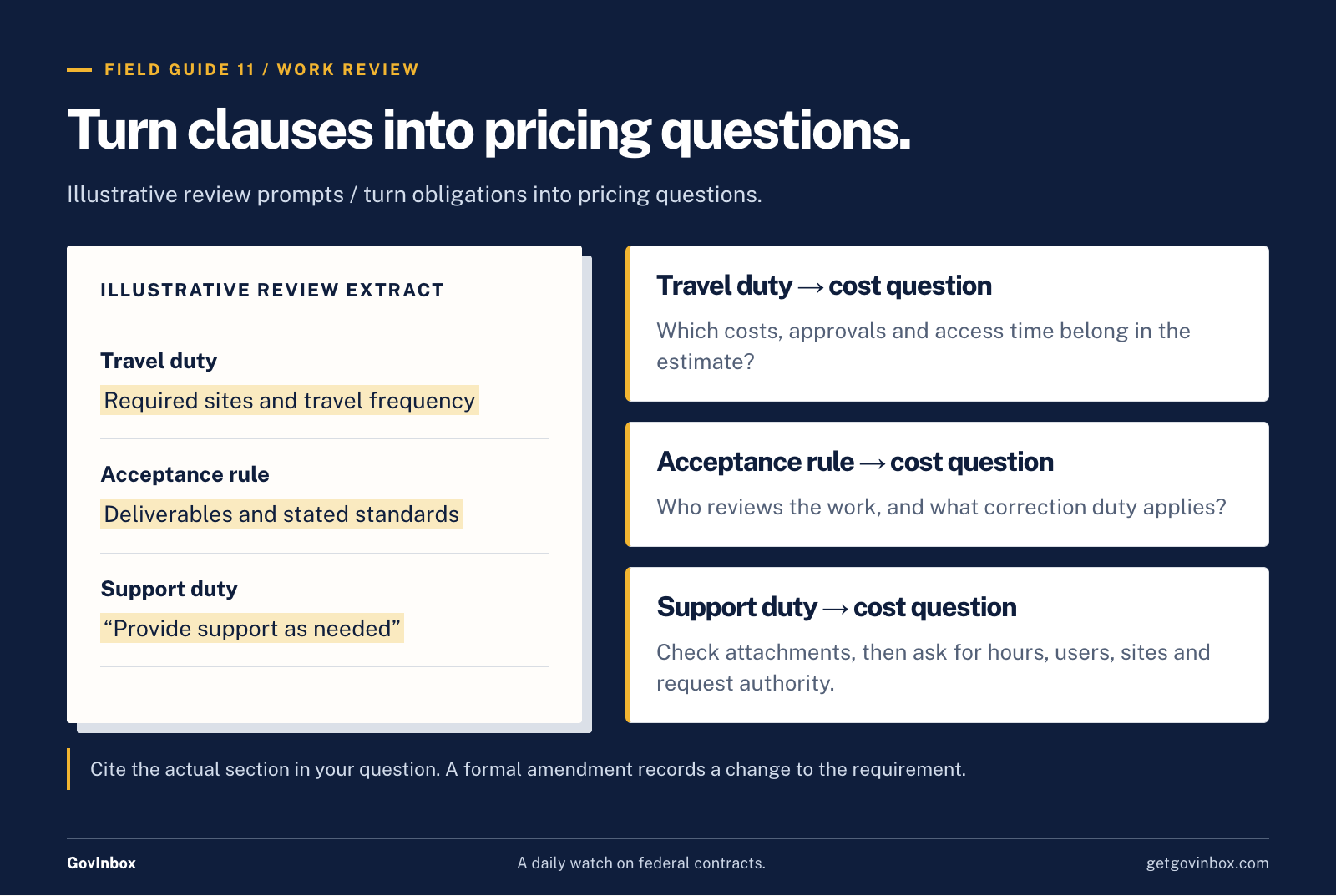
“Provide support as needed” leaves room for questions.
How much support? During which hours? For how many users or sites? Who can request it?
These are illustrative questions, not proof that a notice is defective. Check the rest of the documents first. A workload table or attachment may supply the missing limits.
If the answer remains unclear, ask the contracting officer, the government official authorized to handle the contract, through the stated question process. Cite the section and ask for the limit you need to price the work.
Find revision and rework duties
Look for language requiring corrections or revisions.
Repairing work that fails a stated standard is different from repeated changes to an approved requirement. Check which situation the clause covers.
If the document seems to allow unlimited revisions, ask how review rounds work and who approves the final version. Find any deadline for government comments and any rule for changes after acceptance.
Do not assume your usual customer policy applies. A limit written in your proposal may conflict with the solicitation, the government’s request for responses.
Read every travel requirement
A travel duty buried in section 7 can change your price even if the opening summary says little about it.
Check the place of performance, where you must work, and each required site. Find the expected frequency of travel and who pays for it. Review whether travel needs prior approval.
For on-site work, consider access time and working hours. An escort requirement can affect staffing even when the task itself is straightforward.
Use the full document set to resolve these questions. A pricing attachment may explain how travel should be quoted.
Check experience requirements elsewhere
A past-performance threshold, a minimum standard for evidence of prior work, may appear outside the SOW. It could sit in submission instructions or evaluation criteria, the rules used to judge your response.
Keep bidding requirements separate from delivery duties. You might be able to perform the job but lack the evidence required to compete.
Read attachments and clauses incorporated by reference, meaning rules included through a citation rather than printed in full.
Turn questions into a cost review
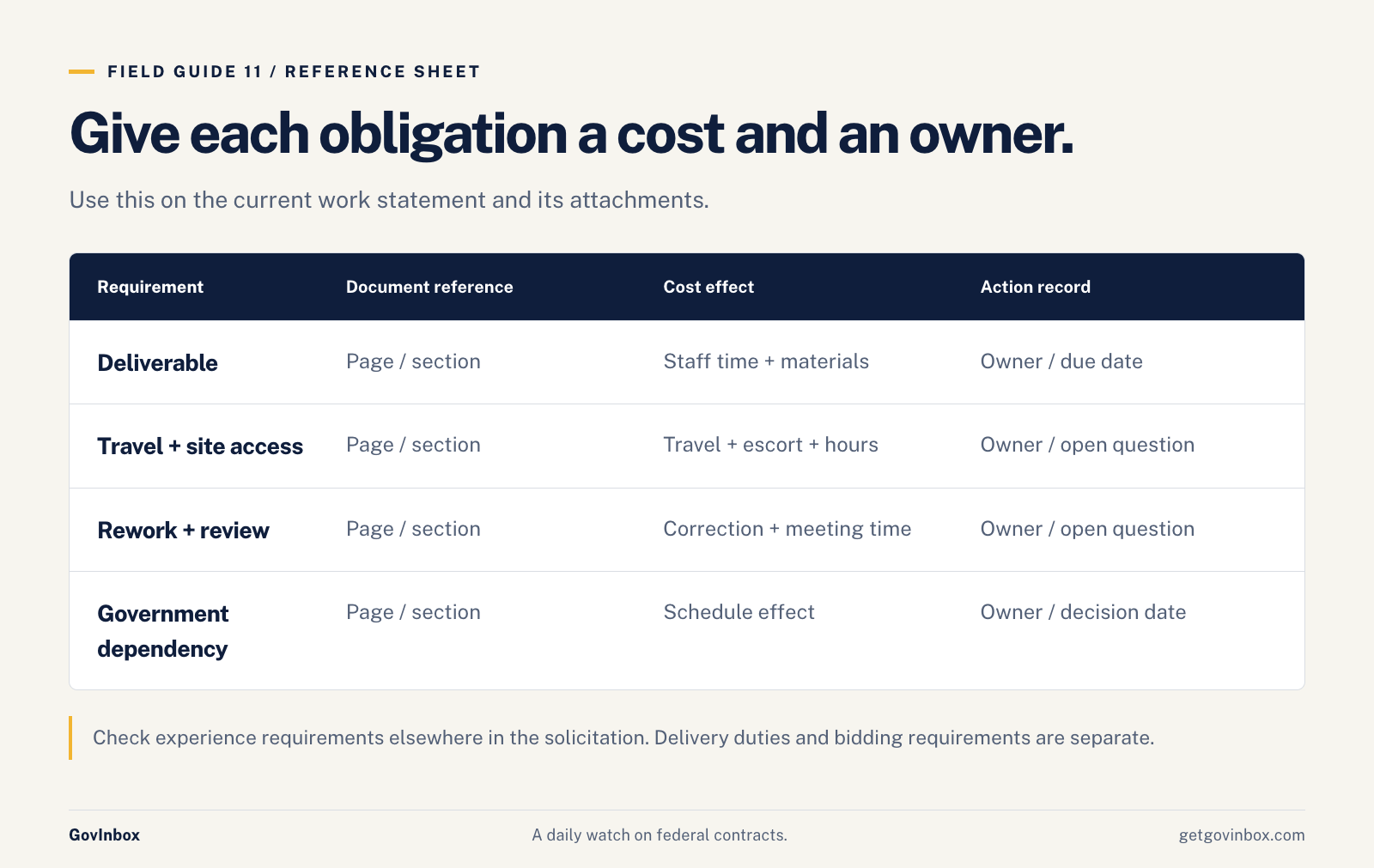
Build a simple table with a requirement, document reference, cost effect, and open question for each concern.
For example, a required review meeting may need staff time that your initial estimate missed. Add that time to the estimate and check whether the meeting frequency is defined.
When an answer changes the requirement, look for the formal amendment, the official update to the solicitation. Federal rules explain solicitation changes.
Your SOW review checklist
Before committing to a price:
- I can describe the scope and its limits.
- Every deliverable has an owner and due date.
- Acceptance standards are clear enough to plan the work.
- Revision and rework duties are understood.
- Travel, site access, and working hours are priced.
- Government-provided items and dependencies are identified.
- Experience requirements have been checked across all documents.
- Referenced clauses and current attachments have been reviewed.
- Unclear obligations have written questions and decision dates.
Take the SOW for your next opportunity and mark each obligation you have not yet included in your estimate. Resolve those gaps before submitting your price.