The one-page capability statement
Published
A buyer asks what your company does. You could send a website link and hope they find the right page.
A capability statement gives them a shorter path. It is a one-page summary of the work your company can perform, with evidence and a way to contact you.
The page should help a government buyer or prime contractor, the company holding the government contract, decide whether a further conversation makes sense. Keep that job in mind while choosing what fits.
Lead with the work
Put your company name and a plain-English description near the top.
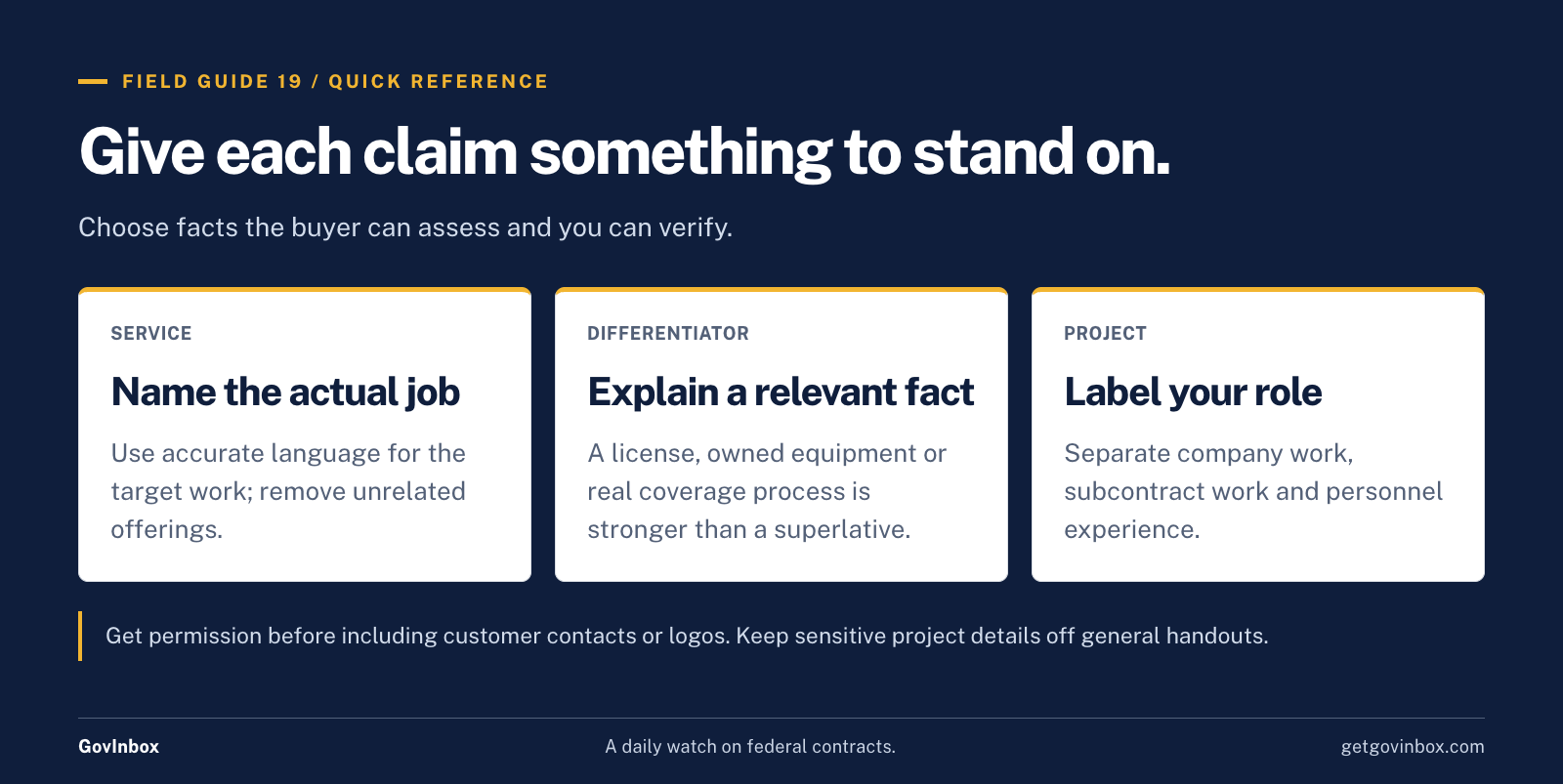
Say what you do and for whom. “We repair commercial refrigeration systems at customer sites” is easier to use than “We provide comprehensive solutions.”
Core competencies are the services or products your company performs well. List the ones relevant to the reader’s needs.
A training buyer should be able to find your training offer without reading about every unrelated service your company has considered.
Use the language of the target work when it is accurate. Do not add a service just because it appears in a federal notice.
Give specific reasons to consider you
Differentiators are facts that help a buyer understand why your firm fits the job.
A relevant license can be one. So can equipment you own or a service area that supports the required site.
“Excellent customer service” asks the reader to take your word for it. A clear process for covering required support hours is easier to assess.
Avoid claims that you are the best or that your service is unmatched. Choose facts you can explain and verify.
The VA’s capability-statement guidance recommends tailoring the page to the buyer’s specific needs. Use that principle to decide what earns space.
Show relevant work
Past performance means evidence of how well you handled prior work.
Use brief project entries that explain the task and your company’s role. Add a factual outcome when you can support it. Commercial work can be useful on an introductory page.
If your firm was a subcontractor, the company performing part of another firm’s contract, label that role. Do not imply your company performed the entire prime contract.
For a new firm, label personnel experience clearly. Work an employee did at a former company should not appear as a completed contract for your business.
Get permission before including customer contacts or logos. Keep sensitive project details off a general handout.
Make company details easy to find
Include a contact who can answer a buying question. Add the email address and phone number, plus your website.
A UEI, or Unique Entity ID, is your company’s identifier in SAM.gov. A CAGE code, or Commercial and Government Entity code, identifies your business location in another government system. Include accurate identifiers when available.
NAICS codes, the government’s industry classifications, help readers connect your business to relevant work. Use the codes that fit the page’s focus.
List applicable certifications accurately. A pending application is different from an approved certification.
Only list contract vehicles, existing buying arrangements, that your firm actually holds. Registration in SAM.gov does not mean you hold a GSA Schedule contract.
Make the page easy to scan
You cannot predict which line every buyer will read first. Give them a clear route through the work you offer and the proof behind it.
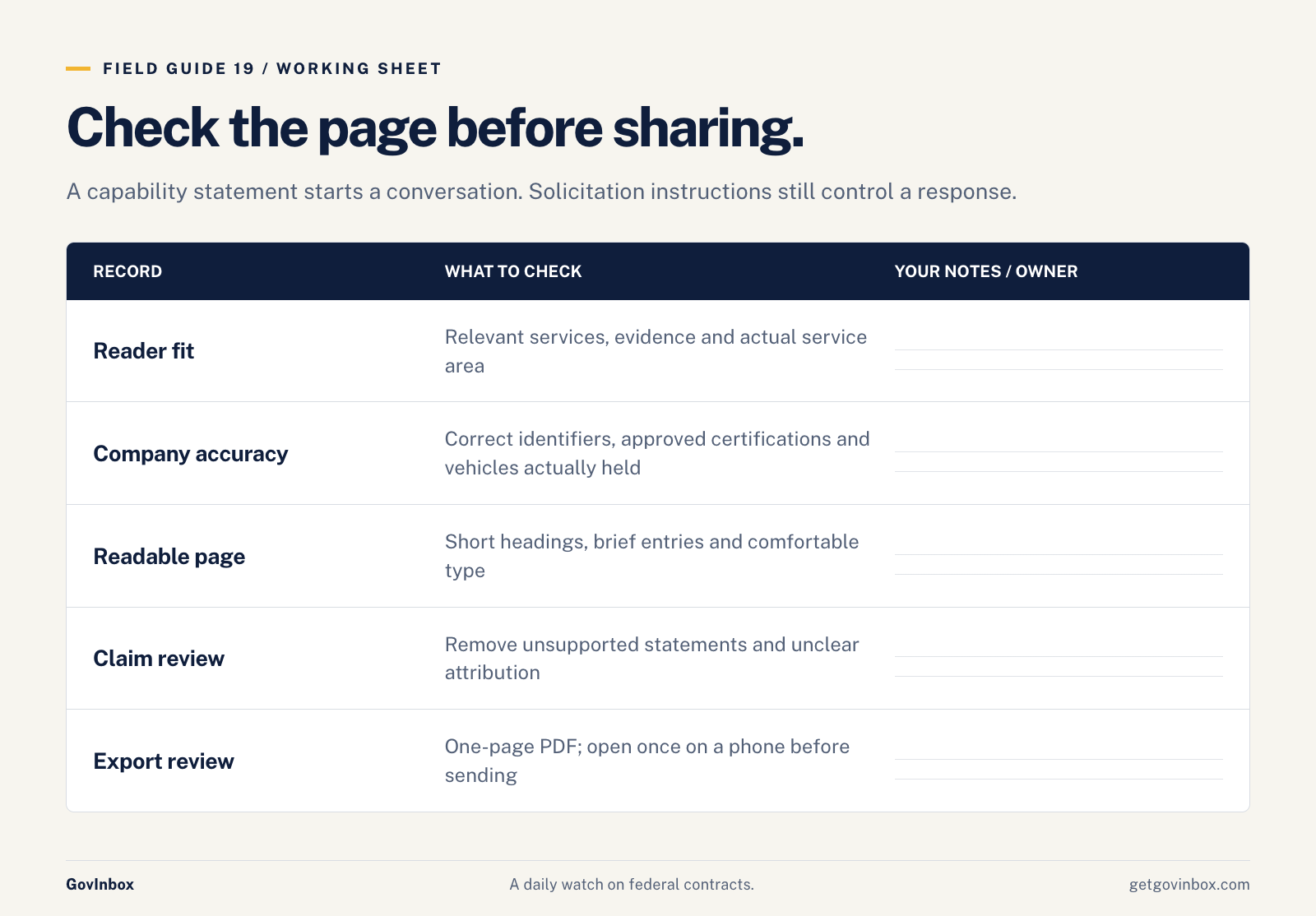
Keep headings short. Leave enough space for readable type. Use brief entries instead of a company-history essay.
A capability statement is a marketing introduction. If a solicitation, the government’s request for responses, asks for a specific format or evidence, follow those instructions.
HHS’s capability-statement guidance provides another official starting point.
Leave these off
Skip unsupported claims and long mission statements. Remove services unrelated to the reader’s likely purchase.
Do not squeeze in tiny text to preserve every detail. Keep additional project evidence ready for a follow-up conversation.
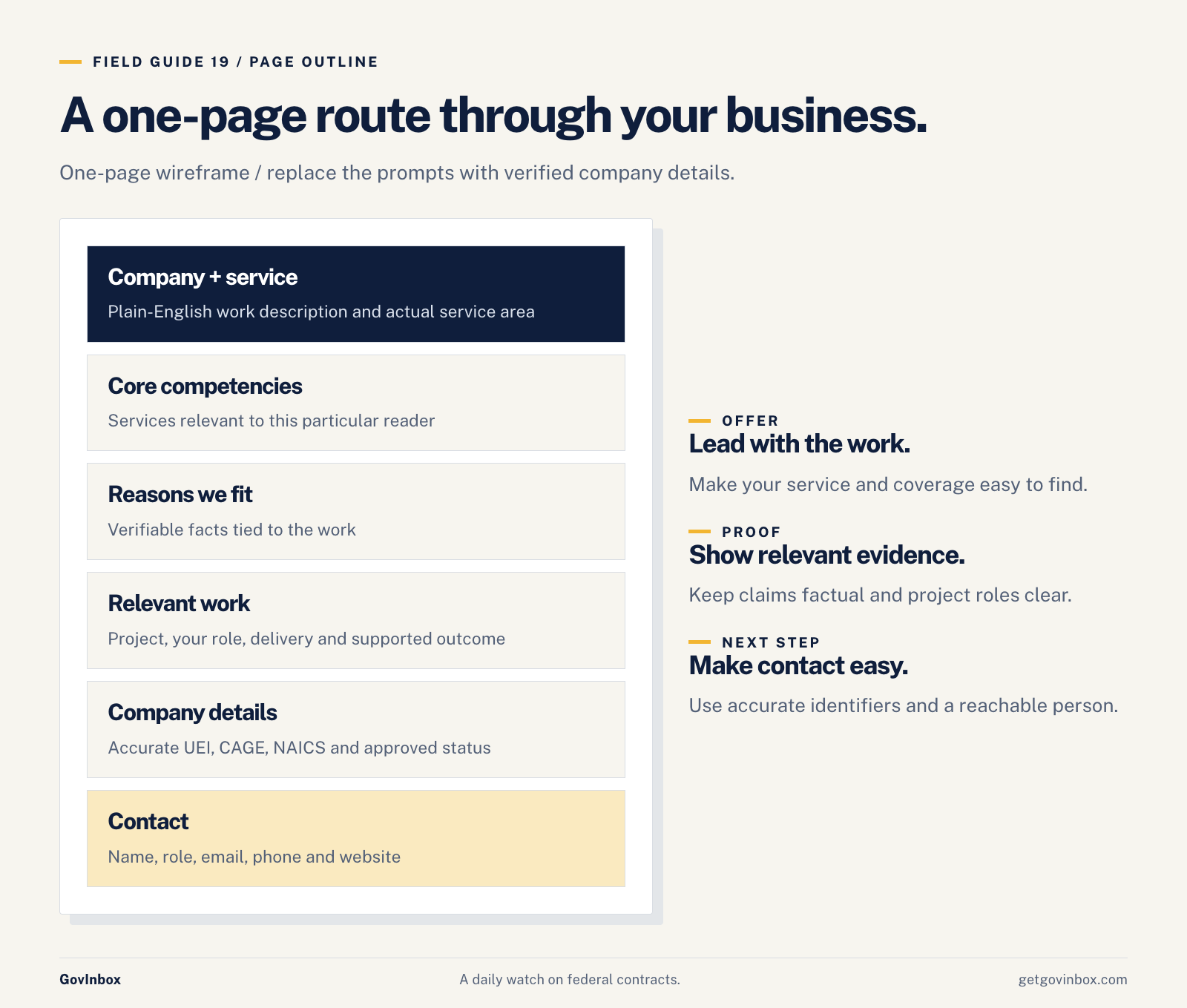
Fill this outline today
Company name: [Legal name or clearly identified business name] What we do: [One plain-English sentence] Where we work: [Actual service area]
Core competencies:
- [Relevant service and its scope]
- [Another service relevant to this buyer]
Reasons we fit:
- [Verifiable fact tied to the work]
- [Another supported fact, if useful]
Relevant work:
- [Customer or project, your role, work delivered, verified result]
- [Additional relevant example, if available]
Company details: [UEI, CAGE, relevant NAICS codes, approved certifications, applicable contract vehicles]
Contact: [Name, role, email, phone, website]
Fill the outline, remove anything you cannot support, and export a readable one-page PDF. Open it once on your phone before sending it.